The Newfoundland Beer Strike of 1985

In 1985 the three major breweries in Newfoundland, Labatt, Carling O’Keefe, and Molson, stopped producing beer. For most of the year, from April until mid-November, there was no commercial beer produced in Newfoundland. Those who lived through the beer strike seem to remember it as a shared trauma or as what the poet and storyteller Ben Ploughman called a collective “hangover,” but for many of us from a younger generation these stories are not at all clear.1

The story of the 1985 beer strike lives on in local legend, but there isn’t really any clear account of what actually happened in 1985. I’ve heard the basic chronology from my father: the breweries went on strike, the liquor board imported American beer – which everyone hated – and, once the strike was resolved, all the American beer was discounted to a ludicrous degree. This isn’t actually too far from what happened, however, I’d like to iron our a few details.

The strike started at the Labatt brewery where unionized workers, protesting the introduction of aluminum cans which they felt threatened their job security, went on strike on April 1.2 The following day O’Keefe and Molson locked out their workers (O’Keefe had about 70 and Molson had about 60) in accordance with an agreement between the three breweries. So, because of this agreement, workers at all three major Newfoundland breweries were either locked out or officially on strike by April 2, 1985.

"Glass is Class, Ban the Can," Union Badge

“Glass is Class, Ban the Can,” Union Badge

The other unions, the ones who were locked out due to covert corporate agreements, were actively frustrated by this action. Kevin Walsh, the president of Local 354 of the United Brewery, Flour, Cereal, Soft­drink and Distillery Workers union, took part in an occupation of the Carling O’Keefe plant in downtown St. John’s in early May. He stated, upset at the lack of official reasoning for the lockout, ”We want to sit down at the negotiating table and work out an agreement.”3 The cause of the strike was not simply a union issue, it had to do with the limited competition in the Newfoundland brewery market and corporate solidarity.

By May many local pubs and taverns were running low on beer supplies. Steve Sparkes, the president of Hospitality Newfoundland, told the Globe and Mail on May 11 that within ” maybe 12 or 14 days… every bar will be out of beer,” and that “[p]eople just haven’t switched to liquor as we had hoped.”4 The solution to the beer shortage was one which many Newfoundlander’s came to abhor: importing larger quantities of American beer.

Ben Ploughman, in his poem “The Beer Strike of ’85,” calls the beer alternatives provided by the Newfoundland Liquor Corporation (NLC), canned beers like Lone Star, Old Milwaukee and Pabts Blue Ribbon, “American froth.” He laments that beers, even Canadian and Dutch ones, like Heineken, Mooshead, and Schooner, just could not “satisfy the thirst / That had plagued this Newfoundland.” Nothing it seems, was as good as Dominion or Blue, his preferred two brands. (I’m uncertain if “blue” is referring to Blue Star or Labatt Blue, but, given the nationalistic context, it would likely be Blue Star.)

In the first four months of the strike/lockout overall beer sales dipped 20 per cent from the previous year and the NLC imported “36 million bottles or cans of beer from the United States and 8.4 million cans or bottles from Europe.”5 Newfoundland was not the only provence struggling with brewing industry labour problems in 1985. There was also a lockout of Ontario’s three major breweries in March of 1985 because of similar union fears that cans would both displace workers and allow for greater beer mobility and centralization.6 These fears of greater brewery centralization also appeared in the Newfoundland strike. Fraser March, president of the Newfoundland Association of Public Employees, stated in a 1985 press conference that: “I believe that the brewing industry has a secret agenda in this province and that secret agenda is to pull all breweries out of Newfoundland and have beer brewed in large regional breweries, one in Halifax and one in Montreal for sure, and have all beer sold in non­returnable cans.”7

The portability of cans seemed to offer a greater ability for breweries to centralize and streamline their production. Because cans could be shipped long distances, unions feared that breweries would move out of a small, regional production model and towards a larger centralized one. In many cases this seems to have happened in the years since 1985, however, notably Labatt and Molson both still operate breweries in Newfoundland and still mostly use the regional Newfoundland semi-short-neck bottles.

Aside from impacting our ideas of canned beer, the strike also raises an interesting point about beer brewing in Newfoundland. Ploughman, in his poem about the strike, writes: “And such the likes were never seen / Of homebrew that was brewed, / From herring barrels and plastics pails / So thick as Irish stew.” It’s interesting to think about what a beer strike and an influx of cheep, poorly received American beer did for the homebrewing movement in Newfoundland. It’s also interesting to think about how almost a year of American imports might have shaped Newfoundland beer tastes, which still tend to favour lighter beers.

The strike/lockout ended in November when the union and Labatt came to an agreement after a 22 hour bargaining season.8 Beer sales had plummeted 15% over the previous year – a drop of almost $15 million dollars. The remaining American beer was discounted to, according to Ploughman, nine-sixty, but apparently sales were still slow. Ploughman continues:

Now what was the government to do
With thousands of leftover froth,
It was decided to hit rock bottom
Six dollars for the rest of the lot.

So us Newfies gave in once more
One final crack at those can of beer,
It was cheeper than a pepsi or coke
We called it `hangover beer of the year.’

The beer strike/lockout of 1985 is an important historical event in the history of Newfoundland. It deals with corporate collusion and market control in the beer industry, union responses to changing labour practices and technologies, beer preferences and brand loyalties, and perhaps even played a part in the growth of a homebrewing tradition in Newfoundland. For those of us too young to remember the strike, let’s be thankful that there are more local options now than ever before and hope that a drought of local beer in Newfoundland will never happen again.


1 Ben J. Ploughman, Born and Bred on `The Rock’: Original Newfoundland Stories, Recitations and Poetry (Creative Publishers, 1988).

2 “Across Canada: Lounge Owners Seek More Beer,” The Globe and Mail, May 31, 1985.

3 “Brewery Workers Impatient,” The Globe and Mail, May 3, 1985.

4 “Across Canada: Newfoundland taverns are running short of beer,” The Globe and Mail, May 11, 1985.

5 “Breweries deny union charges,” The Globe and Mail, August 27, 1985.

6 “Beer flow should resume Monday,” The Globe and Mail, March 16, 1985.

7 “Breweries deny union charges,” opt. cit..

8 “Contract ends Newfoundland beer strike,” The Ottawa Citizen, November 15, 1985.
2 Comments

Filed under Beer Strike, History, Microbreweries

Topics for Research

This is a research blog so I ought to include a summary of some of the topics in Newfoundland’s brewing history I am looking for information about or in the process of researching.

  • The strike of 1986, where the local breweries were shut down for several months causing the import of numerous low-end American brands (Old Milwaukee, Pabst Blue Ribbon)
  • Dominion Ale / Bennett Brewing’s Newfoundland Songbook
  • Other breweries and microbrews. In particular the brewing done at the Duke of Duckworth and the reports of Brewing at Fog City in the Avalon Mall
  • Bison Brewing in Stephenville
  • The homebrew culture in Newfoundland, particularly the story of the homebrew supply shop Brewery Lane
  • Newfoundland Prohibition
  • Details on the takeovers by Molson, Carling, and Labatt
  • More general detail on the key historical breweries (who worked their, etc.)

Any topics you think I’ve missed? Have any information about these topics? Let me know!

1 Comment

Filed under History

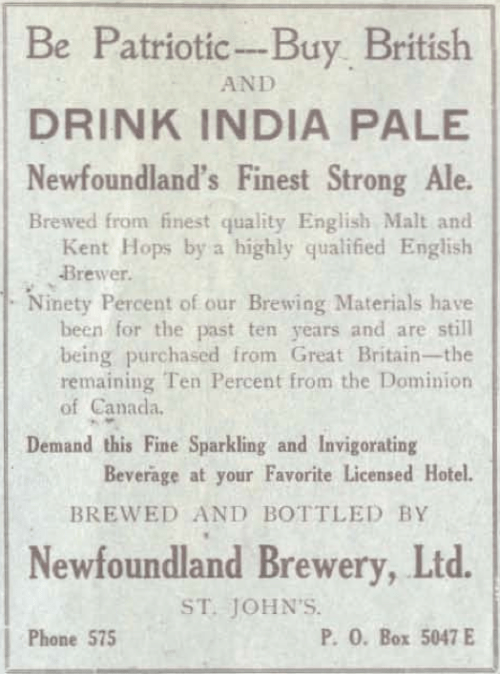
The Patriotic India Pale Ale

I was poking through some old issues of The Newfoundland Quarterly from WWII this morning and I found a really great advertisement for Newfoundland Breweries’ India Pale Ale. It boasts that 90% of the malts and hops used in the India Pale Ale are still from Brittan and that drinking IPA is your patriotic duty. Demand it!

From The Newfoundland Quarterly, Volume 40, Issue 2, Autumn 1940.

1 Comment

Filed under Advertisement, India Beer, Newfoundland Brewery

More on the Quidi Vidi Brewing British IPA

So a few posts back I mentioned that Quidi Vidi Brewing brought the IPA style back to the island after a far too long hiatus. IPA’s are one of the most popular craft beer styles in North America, so it’s really about time Newfoundland started to catch up.

There are several varieties of IPA, the more popular style is the American West Coast IPA which has big fruit and floral aromas from the hops, while the British is slightly more malt-centered with a rich, citrus-copper bitter finish.

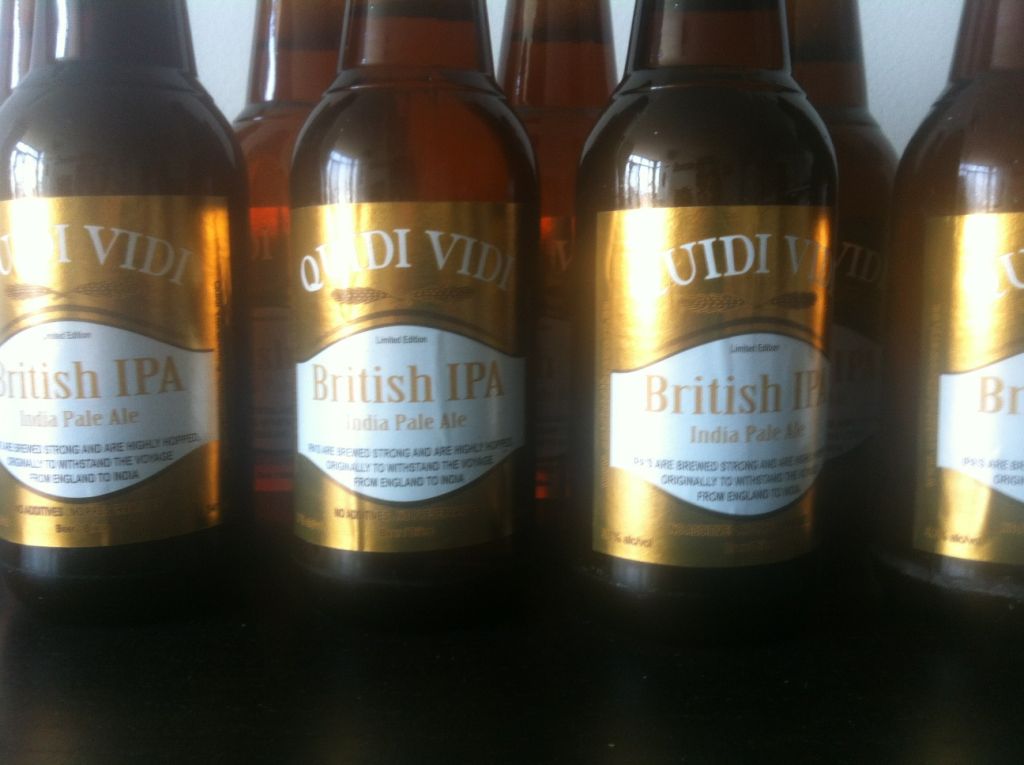
I am very fortunate to have a friend who was willing to ship eight bottles up to Toronto so I could give it a try. I don’t want to discuss the taste to much on here, it’s not the function of this blog to review beer, but I strongly suggest that if you are in Newfoundland then you should to drop down to the brewery and pick up at least a 6 pack! It’s exciting to see beers coming from Newfoundland with a more pronounced hop character.

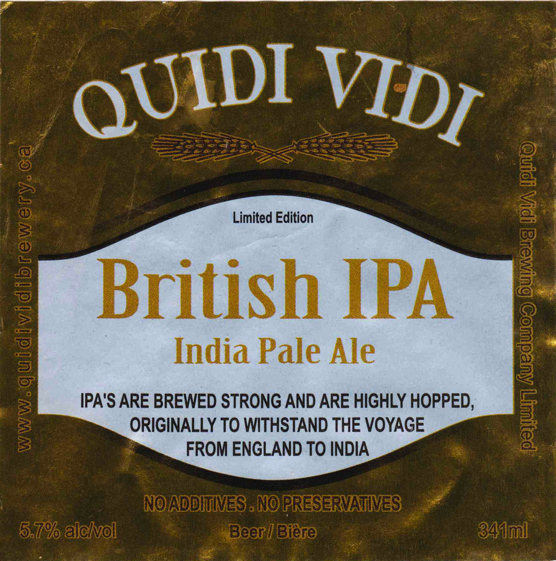
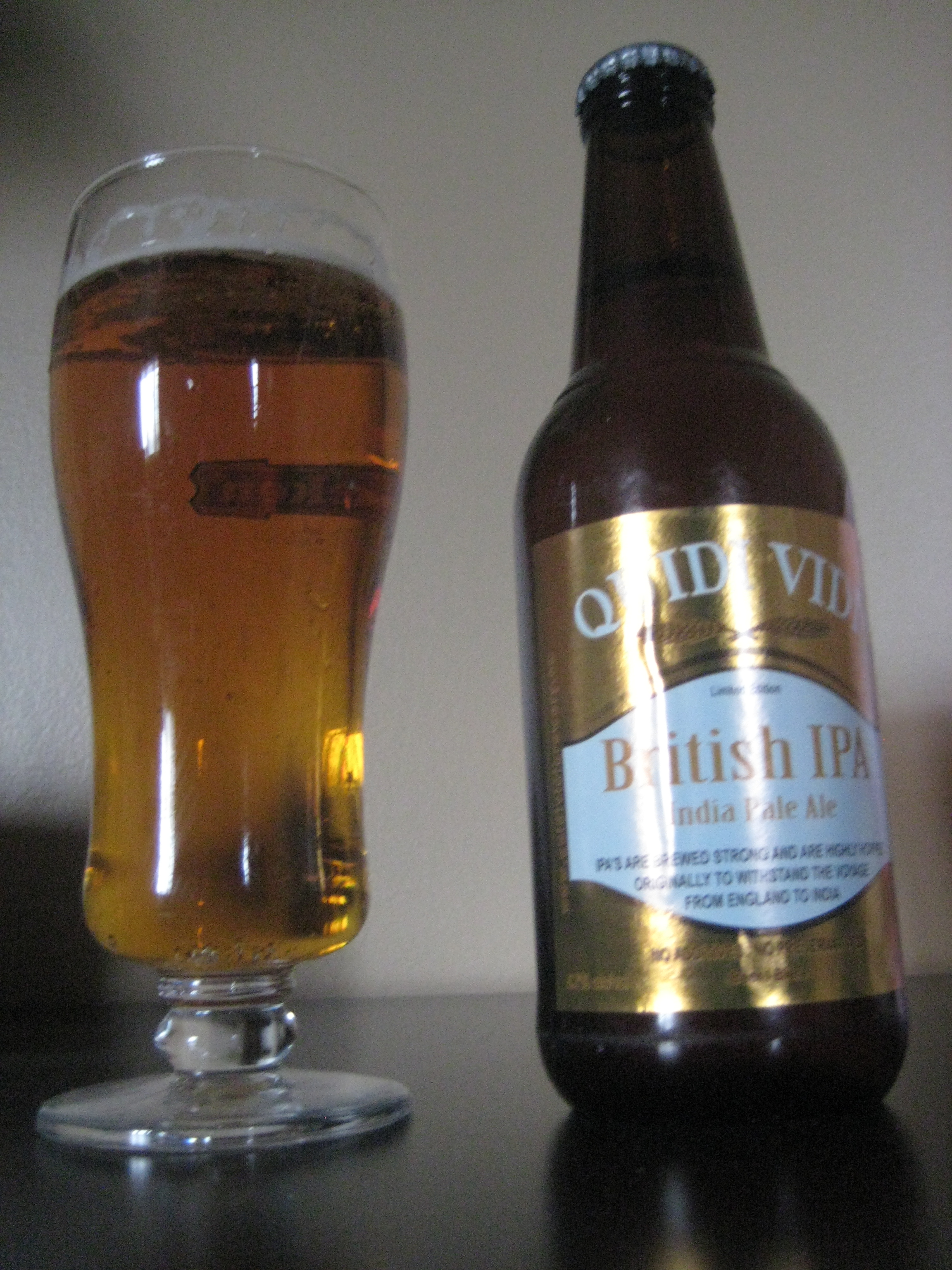
Quidi Vidi Brewing British IPA, circa 2012

The haul in Toronto.

Leave a comment

Filed under Contemporary Beer, Labels, Quidi Vidi Brewing

India, India, India Beer

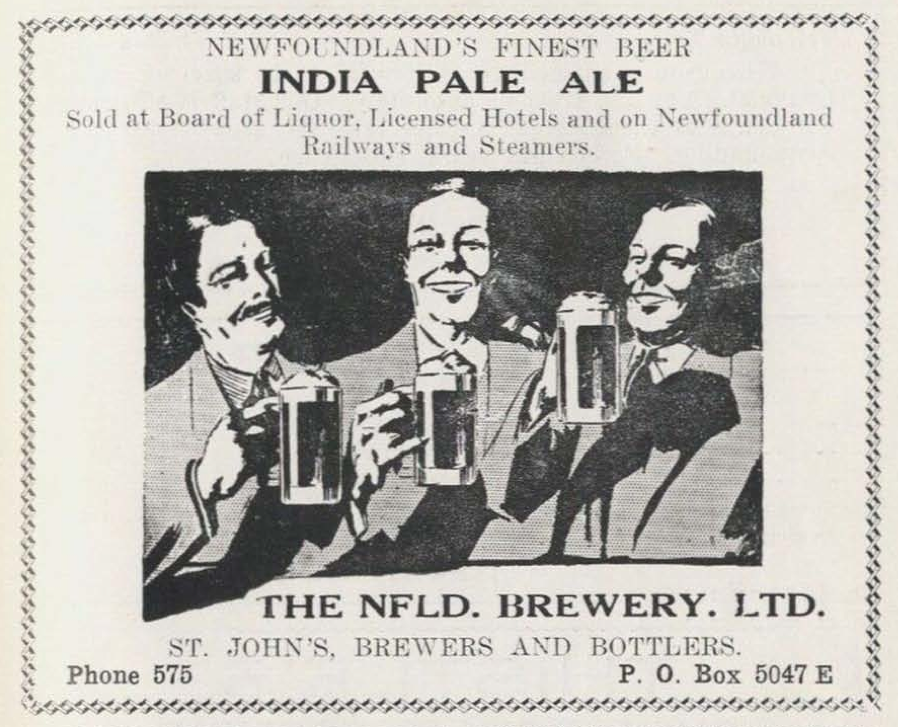
Today, a few more advertisements of beers by the Newfoundland Brewery Limited, India Beer and India Pale Ale.

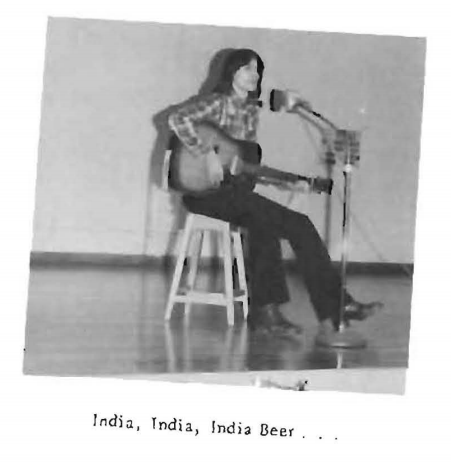
An unnamed young man sings about his India Beer in The Collegian, 1974-1975 (the yearbook of Prince of Wales Collegiate, a high-school in St. John's).

This one from Burkes Ballades (1960?) offers free home delivery!

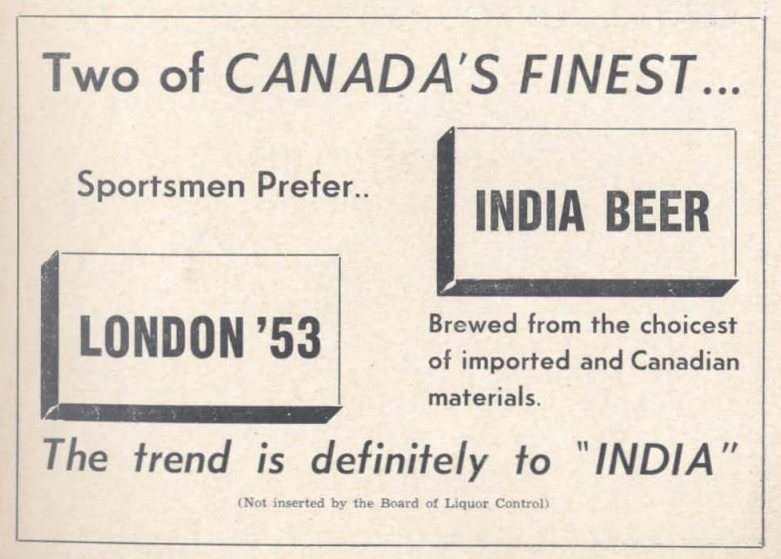
India beer advertised with a lesser known brand, London '53. From The Atlantic Guardian, 13, 1956 (page 23).

From the Newfoundland Who's Who, 1937 (page 13), three men enjoy frothy glasses of India Pale Ale.

Leave a comment

Filed under Advertisement, Culture, History, India Beer, Newfoundland Brewery

The Big Three of Bennett

Bennett Brewing was one of the most powerful and popular breweries in Newfoundland in the 1950s. In the 1950s there were many advertisements claiming that the “big three” beers in Newfoundland were Dominion Pale Ale, Dominon Stout, and Rainbow Beer. Here are a few examples:

The "big three" as advertised in the Adelphian, the school magazine of St. Bonaventure's College in St. John's, in 1955.

A similar advert from volume 13 (page 23) of the Atlantic Guardian from 1956. They were celebrating Corner Brook's amalgamation.

A slightly more bland one from volume 31, issue 4, page 2, of the Newfoundland Quarterly from 1931.

This one, found on the cover of Burke's Ballads (compiled by Johnny White sometime near 1960) celebrates the milestones of Newfoundland's history.

The connection between Newfoundland music and Bennett Brewing is one I plan to explore in a future post. The Newfoundland Songbook in it’s many volumes was presented by Bennett Brewing and/or Dominion Ale is a major part of Newfoundland’s Brewing Heritage. I’ll be reviewing an article by Paul Mercer and Mac Swackhammer “`The singing of old Newfoundland Ballads and a cool glass of good beer go hand and hand’: Folklore and `Tradition’ in Newfoundland Advertising” Culture and Tradition 3 (1978) 36-45.

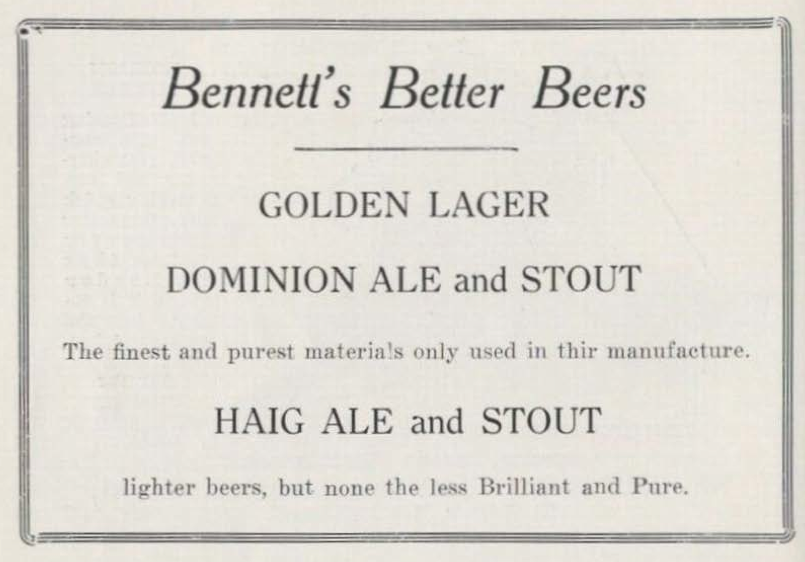
Another somewhat bland advert from the 1937 Newfoundland Who's Who, page 52

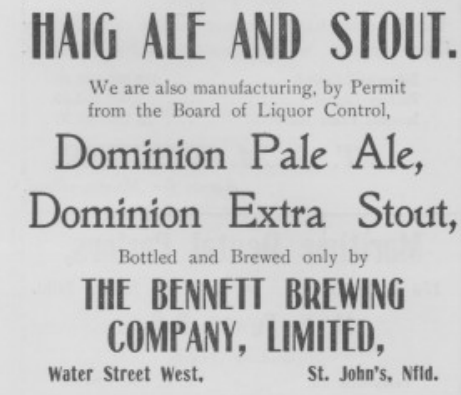
An advert for Haig Ale and Stout from 1926.

It’s interesting to note the medial sounding tone of the 1926 advertisement. This would be from only two short years after the end of Newfoundland’s bout with prohibition, so the medicinal aspect was still quite important, as that is how many of these breweries stayed in business during those years.

Leave a comment

Filed under Advertisement, Bennett Brewing, Culture, History

Quidi Vidi Brewing Release a Seasonal British IPA

This is more about current events than about brewing history, but I am happy to announce that Quidi Vidi Brewing are bringing the IPA style back to the island. No IPAs have been brewed commercially (as far as I know) in Newfoundland for home consumption (though Yellowbelly’s Hodge Podge seasonal was close) since the end of the “India Pale Ale” by Newfoundland Brewery (excepting homebrew, of course).

This is a British IPA, not a more America hop-heavy version, about which they state: “IPA’s are brewed strong and are highly hopped  originally to withstand the voyage from England to India.” While I’m not in Newfoundland right now I do have some pictures provided by my folks.

A picture of the Quidi Vidi British India Pale Ale seasonal, circa March 17, 2012.

A close up of the British IPA label, circa March 17, 2012.


If all goes well I might have a couple of bottles to sample in Toronto later this week. If that happens I’ll update with some thoughts on the taste and a high-quality label scan. Hopefully it’s hopped enough to survive the voyage up!

Leave a comment

Filed under Contemporary Beer, Labels, Quidi Vidi Brewing

Cabot Came Too Soon… for India Beer

More digging through old Atlantic Advocates today has yielded another gem of an advertisement! This old India Beer advert, from 1959, has to be one of my favorite. Note the label is like the one on the timeline, giving us a little more confidence that the diagonal India label was around for most of the 1950’s (that’s the bottle label, not the head stock one). I especially love the slogan “What Newfoundlanders Make, Makes Newfoundlanders,” which would be a great slogan for a contemporary craft brewery.

India Beer advert by Newfoundland Brewery Limited, from The Atlantic Advocate, June, 1959.

Just a note: I’m guessing this was in the June issue due to Cabot’s landfall in Newfoundland somewhere near June 24, 1497. This would have been just in time for the “Cabot 462” celebration!

Leave a comment

Filed under Advertisement, India Beer, Newfoundland Brewery

Get Thee to the Gallows | Beer in The Republic of Doyle

Watching the Republic of Doyle last night (season 3, episode 9, “Mirror Mirror”) I noticed something: beer advertisements for a fake beer! Posted all around the walls of the bar (not the Duke set, another bar that I’ve only seen in this episode) were signs for a beer brand called “Gallows,” with the line (from what I can tell) “Get Sent to the Gallows” as its tag. [Update: see below, it says “Get Thee to the Gallows”]

From around the 38 min. mark.

Grainy zoom-in.

Slightly better lighting.

Another poster was on a different wall, but it’s even harder to make out the text.

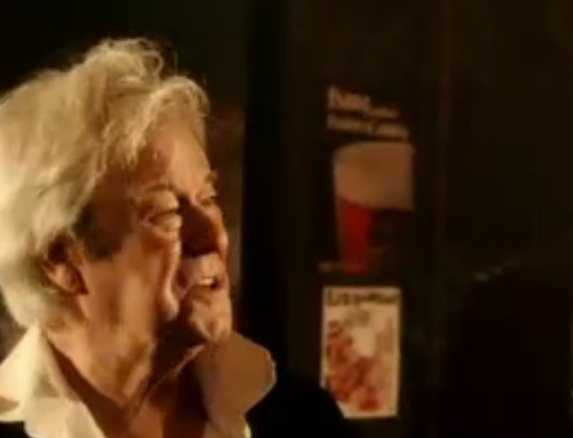
Behind Mr. Pinsent, at around the 12 min. mark.

So, it looks to be a well-headed amber ale that you can get nice pints of on draft. But, to make it even more appealing, you can get a six pack of Gallows in cans as seen scattered about a hungover Doyle in episode 3 (“Hot Package”) of the same season.

Crumpled Gallows cans from around the 5 min. mark.

Until the DVD’s come out I won’t be able to grab any higher quality images of the cans/adverts. It would be really great if they ended up in some of the extras, as I think they are new to this season (other seasons have had subtle Quidi Vidi labels).

The distinctive coat-of-arms logo is pretty clear in this one.

A grainy zoom-in.

One more thing. In the background of the bar (again, not the Duke) there was a lineup of some of the NL-marco brews. Nice to see India beer getting screen time. Again, note the beer on the far right (next to the hula dancer) looks to be a Gallows too. (An amber ale in a green bottle! Preposterous! So much for reality on the television!)

Coors Light, India Beer, Bud Light, Something, and what looks to be a bottle of Gallows beer.

I’d love to find out some more about the branding because even though it’s a fake beer, the Republic of Doyle is a pretty iconic show so it’s interesting that they’ve created a new brand rather than borrowing one from Quidi Vidi, Storm, or Yellowbelly. Couldn’t these all just be 1892 adverts? Maybe Allan Hawco is planning to make a foray into the craft beer business after the show? I doubt it! It’s probably just less paperwork for legal if they make up a brand.

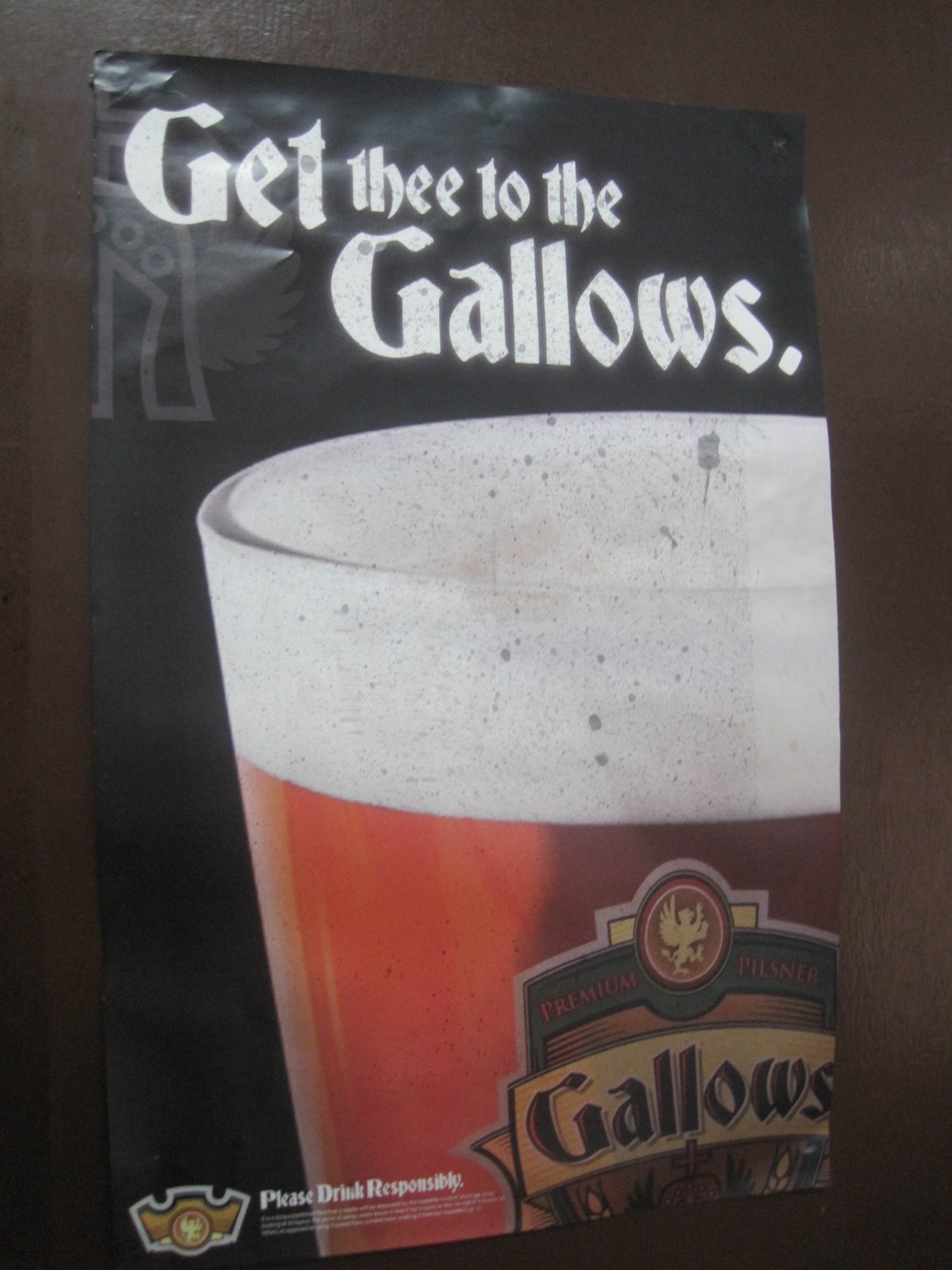
Update: I found an old tweet from @republicofdoyle where there is a nice large picture of the sign! All that work for nothing! It’s a premium pilsner, so I’m imagining it’s like the Barking Squirrel by Hop City because of the similar darker than expected for a pilsner color.

A high-res version!

Major Update (March 15, 2012): So, the week after I made this post a whole episode of the Republic of Doyle was focused on the murder of the owner of the (apparently quite affluent) Gallows Brewery (season 3, episode 10). I might update with a few of the other advertisements when I can.

Leave a comment

Filed under Culture, Labels, Television

The Burger Bar

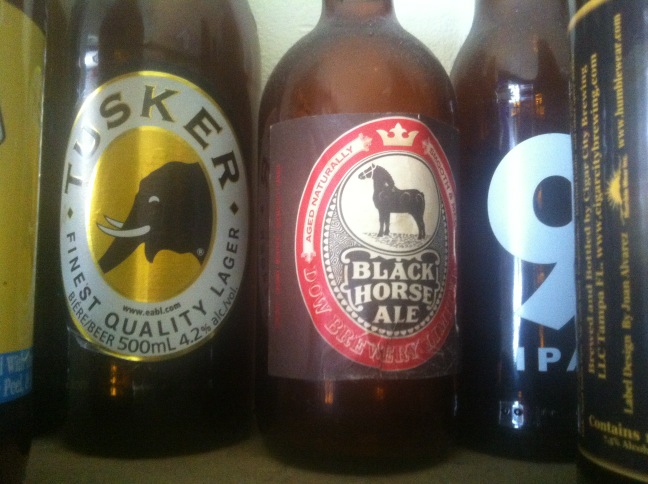
Ok, so the Burger Bar is a great beer/burger bar in Kensington Market, Toronto. They have a large collection of vintage and craft beer bottles lining the walls of the restaurant. I was there for lunch today (drinking a new Ontario craft IPA called Hops and Robbers) and I found this old Black Horse stubby wedged in-between the Kenyan beer Tusker and Duggan’s Number 9 (another local IPA):

Picture taken at the Burger Bar, Toronto. March 7, 2012.

I can only guess at the age of the bottle, but it seems older than the labels that I have. The outside is brown (not golden as it was in the 60’s) but it’s still a square label (not round like up until 1952-ish). My guess is that this was the Ontario version of the label (it doesn’t say “Brasserie Dow” it says “Dow Brewery,” see below) sometime between 1950 and 1970. Also note the difference between the crown in this 1969 label and the older one at the Burger Bar.

1969 Black Horse Label, note the crown and the squaring.

Dawes Black Horse Ale label circa 1939-1952, with a round label.

This might have something to do with the Dow/Dawes connection (see the main page for the history), as the newer crown looks like two D’s. It’s in a stubby too, so, aside from the nice condition, it’s a pretty beautiful thing. Now, if only Burger Bar would put it on the menu!

Leave a comment

Filed under Black Horse, Labels, Material Culture