Category Archives: History

Spruce Beer / Callibogus

A few more notes about Spruce Beer.

First, the good people at Bidgood’s supermarket in the Goulds have published a recipe for making Spruce Beer at home. Click here to go to their page. 

I was also checking out [W J. Kirwin, G.M. Story, and J. D.A. Widdowson (editors)] The Dictionary of Newfoundland English (Toronto, 1990), which is online here (see the entry for spruce and spruce beer here) and I found some interesting usages of Spruce beer. From a savour from scurvy to starting fights and dances which “only the priest” was able to handle, Spruce beer has a distinguished, but often forgotten, role in Newfoundland’s history. Check out the entry for more!

What I found particularly interesting was the recipe for spruce beer from Sir Joseph Banks which appears in Sir Joseph Banks, Joseph Banks in Newfoundland and Labrador 1766: His Diary, Manuscripts and Collections, edited by A.M. Lysaght (University of California Press, 1971), pages 139-140.

Basically, his instructions were to take a 12 gallon copper kettle and “fill it as full of the Boughs of Black spruce as it will hold.” Then press them down, fill with water and boil it until the “rind” of the spruce will easily come off. This, he says, will “waste it about one third take them out.” To this spruce-infused water, he now says to add 1 gallon of molasses (“Melasses”) and boil until disolved. In a half hogshead (google tells me this is around 120 liters, so I’m guessing it’s just a big fermenter) combine 19 gallons of water and the mixture of spruce water and molasses. To finish “work it with Barm & Beergrounds & in Less than a week it is fit to Drink!” Barm is just the foam that forms on top of fermenting beverages, like beer and wine, so that’s the yeast source I’m guessing. That’s it!

He goes on to say (this is from the book, not the dictionary entry) that it’s a pretty weak liquor and that three kinds of “Flip Cald” can be made from it:” “Callibogus, Egg Calli & King Calli.” The term “Calibogus” is actually in Merriam Webster, but spelled with only one “l” (I’ll stick with Sir Joseph’s spelling). Callibogus, he states, is made from adding rum, brandy, or gin to the spruce beer. Egg Calli is made by heating Callibogus with egg and sugar, while King Calli is made by adding “spirit to the contents of the copper as soon as it is ready to put into the cask and drinking it hot.” I’m guessing the last one is just unfermented spruce beer combined with rum, brandy, or gin for those too impatient to wait a week. Can’t beat homemade Callibogus!

Leave a comment

Filed under Callibogus, History, Recipe, Spruce Beer

More Black Horse Labels

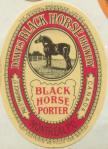
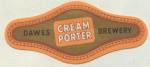
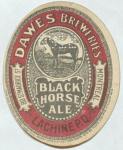
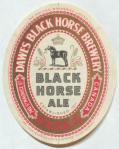
The goal of this project is to consolidate as much Newfoundland beer/brewery history into one place as possible. The Thomas Fisher Rare Book Library, at the University of Toronto, has a large collection of old beer labels donated by Lawrence C. Sherk which have been scanned in very high quality. Since they are creative commons licensed for sharing, remixing, or commercializing with the condition that “[y]ou must attribute the work in the manner specified by the author or licensor (but not in any way that suggests that they endorse you or your use of the work),” here are a few of the older Black Horse ones:

Leave a comment

Filed under Black Horse, History, Labels

More Vintage Advertisements

A few more advertisements! These are from Patrick Kevin Devine, Ye olde St. John’s, 1750-1936 (Newfoundland Directories, 1936):

Advertisement for India Pale Ale, page 84.

Advertisement for Bennett Brewery, page 162.

Leave a comment

Filed under Advertisement, Bennett Brewing, History

A Pre-History of Newfoundland Beer

The Encyclopedia of Newfoundland and Labrador (Joseph R. Smallwood and Robert D.W. Pitt (editors), Newfoundland Book Publishers, 1981), page 251, states the following:

Some of the earliest references to beer consumption in Newfoundland appear in reference to John Guy’s colonists at Cupids and in the papers of Sir Percival Willoughby, from 1610 to 1631. Beer was commonly used as an alternative to fresh water by most seafaring nations of the day, and as a result beer was included as a staple of amy fisherman’s and early colonists’ diets. “An inventory of what provisions is Left at the English Coloni [sic] in Cupis Cove in the New Founde Lande [sic]” dating from August 1611 mentions fourteen pipes of beer included in the Colony’s provisions. “A noate [sic] for the provition [sic] of 20 men for Newfoundland” dated April 3, 1613 recommended some fifty hogsheads of beer for the voyage. Another typical voyage of the period, made by Richard Whitborne in 1622, carried twenty-six tuns of beer and cider. Sir William Vaughan (cited in D.W. Prowse: 1895) advised that strong liquor was unhealthy in cold climates such as Newfoundland’s and said that barley water or spruce beer was better for the health.

The first locally brewed beer or cider was probably “beer brewed with molasses and spruce” which Sir Nicholas Trevanions mentions in article 27 of his Orders of the Fishery in 1712 (cited in Prowse). One of the earliest references to an established brewery on the Island appears in a letter from Governor Gambier to Alexander Caine, dated September 13, 1802. Caine was granted permission to establish a malt beer brewery on Mundy’s Brook, which feed Mundy Pond, St. John’s.

In spite of a rising organized Temperance Movement throughout Newfoundland in the mid-and late-1800s, several local firms established breweries or become involved in importing foreign stout, ales and porters, which are often regarded as a treatment for the invalided, feeble or sickly. By 1897 E. W. Bennett’s Riverhead Brewery was producing an Invalid Stout for those in “delicate health.” During this period several local companies became agents for European stouts and ales which were popular in the community. At least two local companies, J. Lindberg and James Baird Limited, became agents for Barr and Company Ale and Dogs Head Bass Bear, Guiness [sic] Stout and William McEwen Limited Beer, and several companies even exported beer products to England. As a result of a strong temperance sentiment throughout the Island most companies during the 1800s also produced Aerated Water (soft drinks) and syrups.

At the beginning of the Twentieth Century, however, public sentiment in favour of restrictions on alcohol consumption resulted in the passage of the Intoxicating Liquor Act (1 Geo. V, c. 1) in 1911, and a tavern-closing curfew of 9:00 pm. In 1917 the Prohibition Plebiscite Act (8 Geo. V. 1 & 2, c. 22) imposed total prohibition on alcohol consumption in Newfoundland. Most breweries simply reverted to their original production of aerated water or “near” beer (containing not more than 2% alcohol) until prohibition was ended in 1924.

What would a spruce and molasses beer taste like? Probably something like this one made by Garrison Brewing in Halifax. I should also note that one of the more popular accounts of Newfoundland’s beer history, from the Newfoundland Liquor Corporation’s Occasions Magazine from Fall 2008, seems to be largely based on this account from the Encyclopaedia.

Even more on Spruce Beer and Temperance in Newfoundland can be found in this article by Lara Maynard, “The National Temperance Drink of Newfoundland,” Oceanside Press Volume 4-Issue 5, page 3. Some one really needs to make a Newfoundland Spruce Beer called “callibogus.”

Leave a comment

Filed under Bennett Brewing, Books, History

Black Horse in Newfoundland

Black Horse is not, technically, a Newfoundland beer, but since it’s only brewed there now and it’s a big part of the culture it counts! It actually dates back to around 1811. Black Horse was first owned by Dawes Brewing in Lachine, Quebec, who merged with Dow (a bigger brewer, bigger than Molson at the time) to form National Breweries Limited (1909). This was bought by Canadian Breweries Limited in 1952, which changed the name back to Dow’s Brewing (as seen on this bottle). Carling O’Keefe bought them out in the 1960s and Carling O’Keefe was bought by Molson in the 1980s. The brand was national throughout Canada in the 1980s under the name Dow brewing, but as of 1997 the name Dow was dropped.

Black Horse Ale - 1969

Black Horse label, 1969

Black Horse Ale - 1970

Black Horse label, 1970

Black Horse Ale - 1972

Black Horse label, 1972

Leave a comment

Filed under Black Horse, History

Overview: Yellowbelly Brewing

Yellowbelly Brewing (2008-)

Location: 288 Water Street.

Brands: Fighting Irish Red Ale, St. John’s Stout, Wexford Wheat, Pale Ale. Plus sessional beers.

Opened by Craig Flynn with brew master Liam Mckenna in July of 2008, Yellowbelly was the first full brewpub in Newfoundland (I’ve been told that Fog City in the Avalon Mall and the Duke of Duckworth had, for at least a little while, brewing operations also). This brewery is a little too recent to really be covered historically, so check out their webpage and this overview from Occasions Magazine for more information. I mean, if I can still remember drinking a pint of each of their beers on opening night, its not that historic, right?

Leave a comment

Filed under History, Yellowbelly

Overview: Storm Brewing

Storm Brewing (Freshwater Brewing Co. 1995-)

Location: Carbonear (as Freshwater), Mount Pearl (as Storm)

Brands: Irish Red, Island Gold, Raspberry Wheat, Coffee Porter. (Retired, or out of common circulation: Hemp Ale, Killick, Kyle mild. The Duke’s Own is also reported to be brewed by Storm using the Duke’s recipe.)

Freshwater brewing was founded in Carbonear, Newfoundland, in 1995 around the same time as Quidi Vidi Brewing, by Nick Murray and Dave Rodgers. In 1997 the partnership has fizzled and it was purchased and renamed Storm Brewing by Michael McBride, a native of North York, Ontario. Overall Storm is a much smaller, more niche, producer of craft beer than Quidi Vidi Brewing. Originally marketed in stubby bottles and industry standard bomber (650 ml) bottles, in 2010 they switched to long neck bottles for their 6-packs. They report that their 7 hectolitre system was imported from the Santa Rosa brewing company of California. A report in The Telegram indicates that they brew only around 300 hectolitres a year.

References:

STORM BREWING in Nfld. Ltd.Storm Brewing, last accessed February 17, 2012.

Moira Baird, “The Big Idea: Storm Brewing in Newfoundland Ltd.,” The Telegram August 16, 2004.

1 Comment

Filed under History, Storm Brewing

Overview: Quidi Vidi Brewing

Quidi Vidi Brewing (1996-)

Location: Quidi Vidi Village

Brands: 1892, Eric’s Cream Ale, Iceberg, Honey Brown, Premium, and Light.

Quidi Vidi Brewing, founded in 1995 (and first brewing in 1996) by David Rees and David Fong, was the first independent brewery to open in Newfoundland since 1962. It was built, and is currently, on the site of the old Cabot Seafood Plant in Quidi Vidi Village, St. John’s. On their website they say that they were inspired by the craft beer scene in North American and wanted to import a little of that spirit back into Newfoundland by breaking with “the non-descript beer styles being produced by the larger breweries.” They produce using only water, malt, hops and yeast without additives or preservatives, with the exception of honey in their Honey Brown.

In many ways Quidi Vidi has attempted to compete with the major macros by focusing on Canadian lager (“QV”) and light lager (“QV Light”) styles, providing a high alcohol lager (“7”), and attempting to innovate with a beer-cooler which was flavoured with Purity syrup (“Cranberry Cloud”). Both 7 and Cranberry Cloud have since been discontinued. A recent rebrand of their bottles, making QV simply “Premium Lager” and  QV Light with “Light Lager,” and rebranding “Eric’s Red Cream Ale” to “Eric’s Cream Ale” to avoid the constant expectation that it may actually be a red beer. “1892” is what they call a “traditional ale” which has been designed to emulate what beer may have tasted like in 1892, the year of the great St. John’s fire, by using the hop varities which would have been imported to Newfoundland at the time (largely Saaz hops, if memory serves). In 2011 they updated their Christmas “Mummer’s Brew” into a seasonal beer series, the second of which is a British IPA, making it the first IPA to be brewed commercially in Newfoundland since the demise of “India Pale Ale” by the Newfoundland Brewing Company. World-wide they are known for their “Iceberg beer,” which comes in a unique blue bottle and is made from melted iceberg water.

Just for full disclosure, I have probably drank more 1892 than any other beer. It’s very, very close to my heart.

The Quidi Vidi Brewery Beer Wall

The beer wall at Quidi Vidi Brewery circa 2011/2012

Bonus! A video from user CanadianTourism’s youtube channel (click on the video for more from CanadianTourism) where Dave discusses Iceberg beer. It’s not actually 15 minutes outside of St. John’s, it’s just on the outskirts of the East End. It’s actually about a 15 minute walk from where I grew up!

References:

“Occasions Magazine – Newfoundland Liquor Corporation: Quidi Vidi Brewery – Celebrating 15 Years” Newfoundland Liquor Corperation Summer 2011

Our StoryQuidi Vidi Brewing Company 2012, last accessed February 17, 2011.

Leave a comment

Filed under History, Quidi Vidi Brewing

Overview: Kavanaugh and Company

Kavanaugh and Company (1890-1936?)

Location: Military Road and 18 Water Street West.

Brands: Mostly “aerated water” but listed as a brewery.

Likely cause of death: Unknown.

References:

Joseph R. Smallwood and Robert D.W. Pitt (editors) Encyclopaedia of Newfoundland, Volume 1 (Newfoundland Book Publishers, 1981, under the Breweries entry)

Leave a comment

Filed under History, Other Brewers

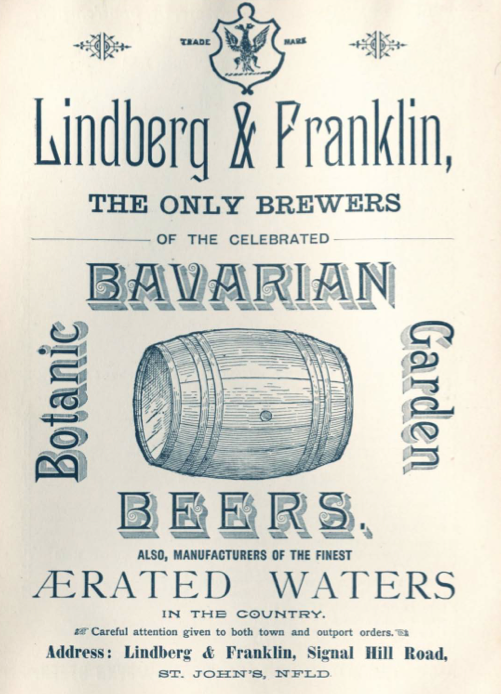
Overview: Lindberg Brewing Company

Lindberg Brewing Company Limited (1877-1912?)

Location: Signal Hill Road.

Brands: Bavarian Beers and imported Guinness and Bass.

Likely cause of death: Liquor restriction laws (bars to close at 9 p.m.) (1911) and Newfoundland Prohibition (1917-1924).

Bavarian Beers, Lindberg and Franklin

Bavarian Brewing advert from McAlpine's Newfoundland directory, 1894 to 1897

References:

Joseph R. Smallwood and Robert D.W. Pitt (editors) Encyclopaedia of Newfoundland, Volume 1 (Newfoundland Book Publishers, 1981, under the Breweries entry)

McAlpine’s Newfoundland directory, 1894 to 1897.

Leave a comment

Filed under History, Other Brewers