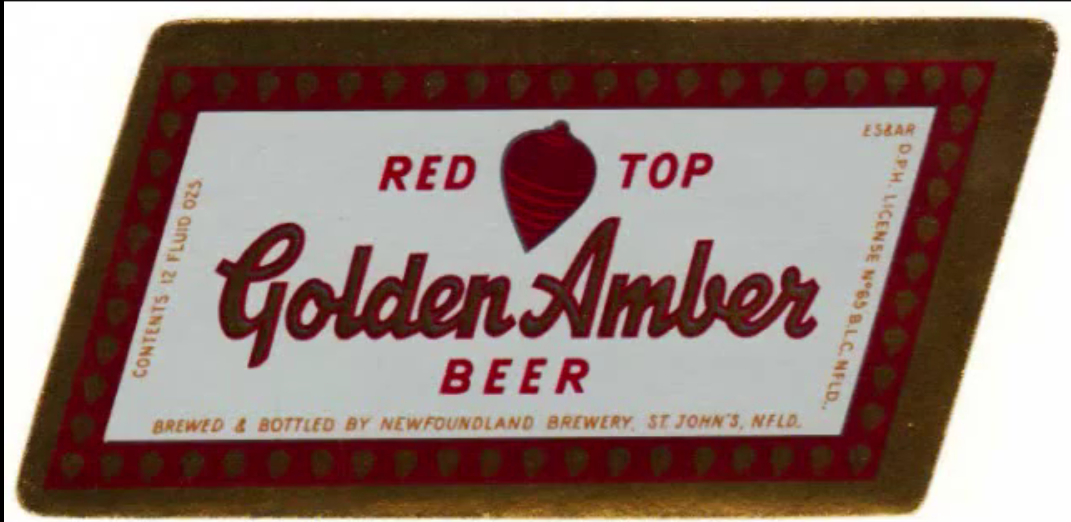
Red Top Golden Amber Beer

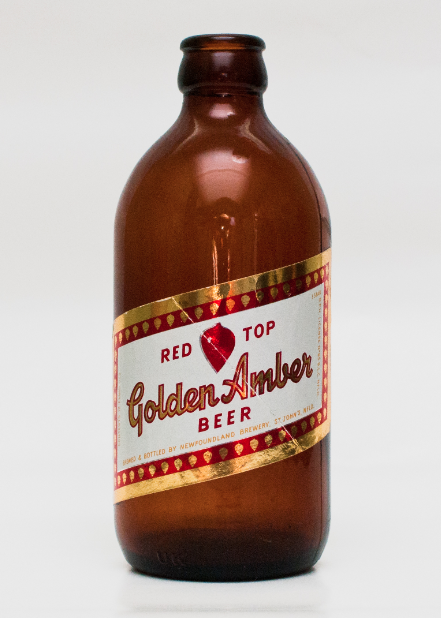
Occasionally I find a beer that I don’t know too much about, so I don’t really know what to write when I want to post a picture. Case and point: Newfoundland Brewery’s “Red Top Golden Amber Beer.”

Newfoundland Brewery’s Red Top Golden Amber Beer, my collection.

I found this bottle down at Livyers’ Antiques on Duckworth Street in St. John’s in June of 2012. All I really know about it is that it was brewed by Newfoundland Brewery, probably before 1962, though the stubby makes me question that. Stubbys were usually a little later into the 1960s, but it could be that the Newfoundland Brewery was ahead of the curve.

It’s a very heavy stubby and the corners feel more well rounded than many more modern examples. It feels very solid even compared to the 1970s bottles from the Atlantic Brewery.

So that’s it. A bottle that I know very little about other than from inference. Well, at least it’s a looker!

Leave a comment

Filed under Labels, Newfoundland Brewery

The Scoop on Storm Brewing in Newfoundland

Storm Brewing Newfoundland, as I discuss in my overview, was one of Newfoundland’s first microbreweries. In this post, I’d like to speculate a little on the current situation of Storm Brewing and to post a few pictures of the wonderful beers they have made over the years.

My understanding of Storm’s current production situation is that it is basically a part-time job for the owners. As far as I can tell, they run at capacity right now and, because of high demand, their beer sells out of the few NLC and corner stores where they retail in short order. I get no inclination that an expansion or new product is on the way, so I’m guessing that right now it is a pretty happy self-sustaining cottage industry. Their demand excedes their supply, so they seem to be pretty economically stable.

Let me put my bais out there: I love Storm. They were one of the first craft breweries I developed a deep loyalty too. In the mid-2000s they had a “Free Newfoundland” stubby bottle of their Irish Red that I was particularly attached to:

Storm Free Newfoundland Stubby, c. mid-2000s, my collection.

Now, they switched out of stubbys a couple of years back (2008, if memory serves – but check that date) and they use “mainland long-necks” (i.e. not the semi-necks Newfoundland is famous for).

Storm was also the first brewery that introduced me to the “bomber” bottle. Used pretty much religiously throughout the United States craft beer scene,  a bomber was unheard of in Newfoundland before Storm. All of their current four beers are available in the very industry standard bomber.

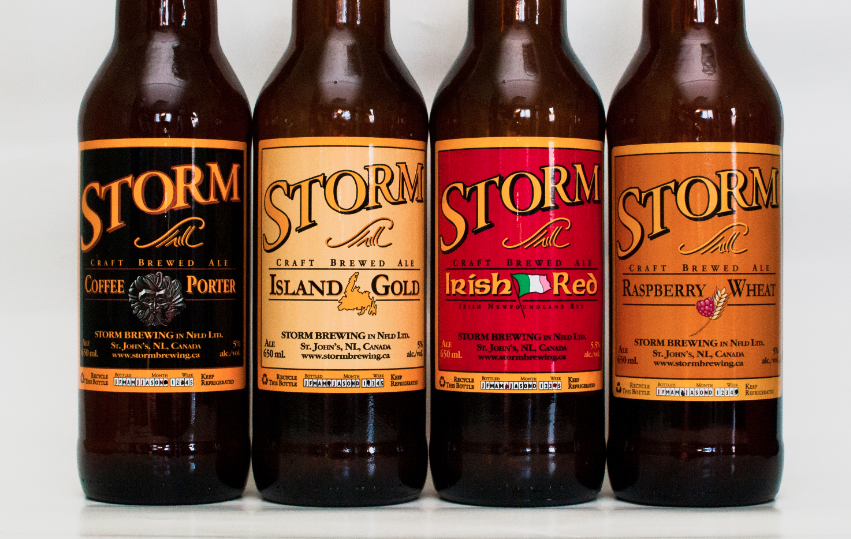
Storm Bombers, c. 2011-2012, my collection.

In the above photo we can see their winter seasonal Coffee Porter, their all year-round Island Gold and Irish Red, and their summer seasonal Raspberry Wheat.

What’s also great about Storm is their dating system. What’s great about it? Well, (a) they have one – something which beer geeks in the United States lament not having even on some top-shelf beers, and (b) it’s clear and uncomplicated. In the dating system, Storm is, well, best kind.

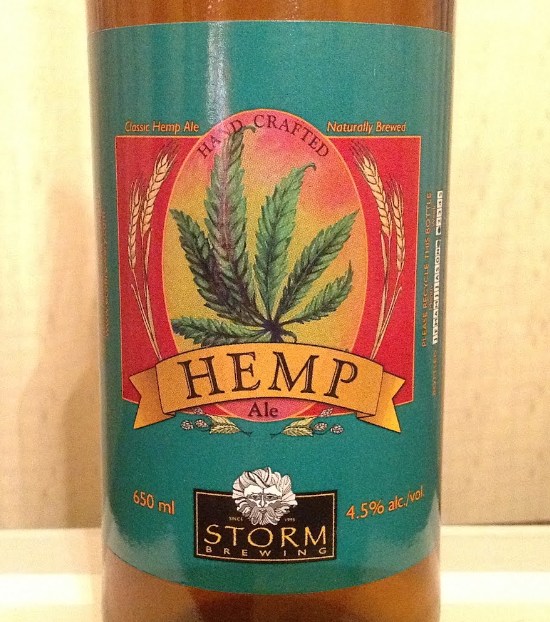
Storm used to be a little more adventurous too. Take, for example, this beer.

Storm Hemp Ale, c. mid-2000s, photo credit Colin Power.

Aside from their lovely old logo (that lives on in their coffee porter symbol), it was a hemp ale! In Newfoundland! I remember really liking this beer and being quite sad when it was discontinued. Hemp ales are pretty rare, even on the mainland, so it was nice to have something pretty unique front-and-center in Newfoundland.

I suspect Storm’s solid economic situation is not pressing them to innovate too much anymore. I mean, if you’re at capacity and constantly in demand then you can take a “if it’s not broke don’t fix it attitude” with impunity. Something in my heart, deep down, however, really wishes they’d kick out a hoppy West Coast IPA or a high gravity Imperial Stout – just something that the drooling beer geeks and home-brewers of Newfoundland could point to and say “look Canada, Newfoundland is not so far behind.”

Will Newfoundland ever start to catch up to Canada, or even to the maritime provinces, in craft beer and modern beer styles? I’m not really sure. But one thing is for sure, in Newfoundland’s Beer History Storm wrote the chapter on making a modern North American style craft brewery, with recognizable craft beer styles, work in Newfoundland.

2 Comments

Filed under Culture, Labels, Overview, Storm Brewing

Dominion Ale and India Beer Bottles

I was looking though some photos of old Newfoundland beer bottles I took on my trip back home in June of 2012 and noticed that I haven’t posted all of them! In particular, I had missed posting some old Bennett Dominion Ale and India Beer bottles.

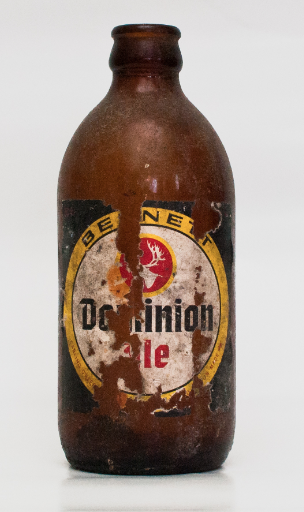
First, a pretty sad specimen that I found in my parents garage. It wasn’t really preserved with care!

A pretty sad specimen of the 1980s Bennett Dominion Ale stubby, my collection.

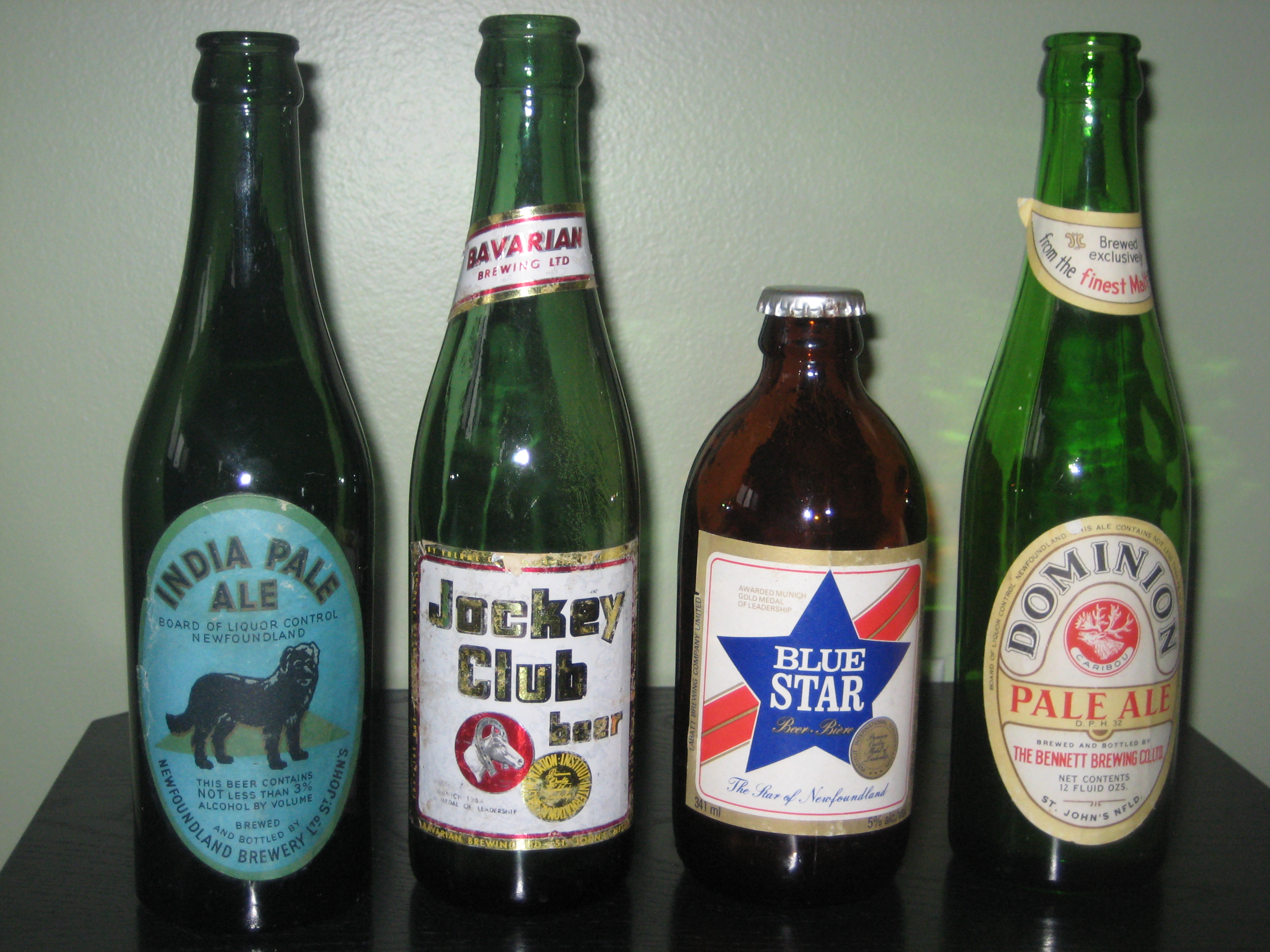
The next is a collection that I picked up from a collector in Grand Falls. It has an old India (1960s), a Jockey (1960s), a Blue Star (discussed here), and a much older Dominion (1960s).

Here is a bit of a close up of the Dominion “Brewed exclusively from the finest malt and hops” and the old blue India label.

Dominion Ale, c. 1970s, my collection.

India Beer c. 1970s, my collection.


The blue India label is, of course, not the original parallelogram-style label that you can see on the main overview. Speaking of that design, however, reminds me of an odd bit of internet reflexivity.

The Obsolescence Project that takes beautiful pictures of old objects recently featured an old india beer bottle. It’s one of the old  parallelogram-labels and they even link to nlbeerhistory.com as a useful and “incredibly comprehensive site” for finding out about Newfoundland’s beer history. That’s little ol’ me! So, please do check out their fantastic photos.

They have also featured an old Dominion Ale stubby that is also well worth checking out!

1 Comment

Filed under Bennett Brewing, Dominion Ale, India Beer, Labatt, Material Culture, Newfoundland Brewery

The Atlantic Brewery

Throughout this site I’ve covered a great number of Newfoundland’s former breweries. One that I’ve really neglected  has been the Atlantic Brewery in Stephenville. On the overview I link to this page which gives a good overview of the brewery’s history, so here I want to write a few interesting points from that article and include a few pictures from my collection.

The Atlantic Brewery, a high-budget ($2.5 million, that’s almost $4 million using a rough inflation calculation – that’s a lot for any brewery) project, opened in 1968 with a staff of 50 people. Within a year the brewery reduced its workforce and then shutdown. Why it failed doesn’t seem to be obvious. It might be a case of “too big, too quick,” but until I hit the archives for some old newspapers I can only speculate.

The Brewery produced, to my knowledge, two primary beers. Their flagship was Atlantic Lager.

Atlantic Lager, my collection, 2012.

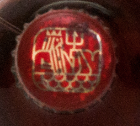
It came in a pretty simply stubby with the Atlantic Brewery’s logo, which looks a bit like Poseidon to me. The bottles I have, I have two (the better condition one is pictured), both still have beer in them. According to the person at Livyers Antiques, who I purchased the bottles from, many of the bottles were left over as unsold surplus after the brewery closed and ended up not being drank. So, if you find a bottle it’ll likely be full! This might also account for why the brewery closed. How bad does a beer have to be that most of the old bottles you find aren’t opened?

Atlantic Cap (Red), my collection, 2012.

Atlantic Cap (Blue), my collection, 2012.

The brewery also made another, apparently less popular product called “Atlantic Draft.”

Atlantic Draft, my collection, 2012.

According to the person I bought this one from Draft bottles are considerably more rare. Considering the short lifespan of the brewery, it’s remarkable that any survive at all!

Once the brewery closed in 1969 it was purchased by the Bison Petroleum and Minerals Ltd. from the government. The brewery appears to have gone bankrupt and into receivership, so most of the $1.1 million purchase price was paid to creditors and the rest paid in bonds to the government of Newfoundland. Bison rebranded the brewery and increased production (from 200,000 cases to 400,000 cases) and invested new money to enter the export market.

Bison Brew Beer (Bison Brewing) see this post for more on this label.

The rest is pretty well put by the article linked above, so here is what they say:

By 1973, the Bison Brewing Company was on the way out of Stephenville. The brewery started laying off workers in the winter of the same year due to a slow period in the brewing industry. By the end of 1973 Bison Petroleum had left Stephenville. This was also due to a major flood that caused more than $1 million in damages to the facilities. However, at this time Stephenville Brewery started up and became a successful operation. Even though Bison Petroleum was only in Stephenville for three years, that three years was enough to get the area’s economy back up and running again. The brewery gave life back to the town after the base closed down. In 1974 Labatt Breweries began operations at the site. This establishment operated until the fall of 1981. At that time personnel were laid off and the Stephenville brewerie’s responsibilities were transferred to St. John’s.

So that’s the brief history of the rise and fall of the Atlantic Brewery. It’s useful to note for dating bottles that if a Labatt brand (like Blue Star or Jockey) says “St. John’s and Stephenville” then it’s likely from between 1974-1981. It’s too bad about the Atlantic Brewery, it’d be nice to have breweries outside of the Avalon today, even a small one making local craft beer (though the scope of the Atlantic Brewery certainly wasn’t to be a craft brewery like we’d recognize today). I also wonder how many more unopened bottles of Atlantic Lager are out there. Anyone want to drink 50 year old beer with me?

1 Comment

Filed under Atlantic Brewery, Labels, Other Brewers

The Evolution of Blue Star

I have been going through some pictures I took (well, had taken) of my NL beer bottle collection and I noticed that I had a great lineage of Blue Star bottles. So, why not take a look at how they’ve changed over the years?

The oldest one I have is from the 1960s:

1960s Blue Star Bottle, my collection

It’s a heavy bottomed glass bottle (thicker than today’s vintage, unless you drink Steamwhistle) with a shiny gold label. It’s the same label I have over on the overview, but this one is still attached to the bottle, which is a plus! It’s still from the Bavarian Brewing era, so it’s likely from sometime prior to, or just slightly after, 1962.

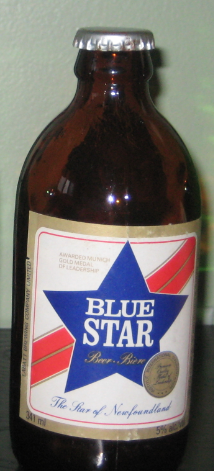
1970s Blue Star Stubby, my collection

This bottle is likely from the 1970s, the era of the stubby. The label hasn’t changed too much, but the red strip has moved into the background and the tag line “The Star of Newfoundland” has been added. It still has the iconic “Gold Medal of Leadership” from Munich in 1954 which is now, as it was then, a pretty cheesy thing to put on a beer bottle.

Blue Star (early 1980s) at the Duke of Duckworth, St. John’s. (2012)

In a longer post I discussed this Blue Star bottle, still full of beer, that’s at the Duke of Duckworth in St. John’s. I dated it from the early 1980s, near the end of the stubby era, because it was kept at the bar (I figured they kept it as a novelty once stubbys became more rare). My dating here is guesswork, so I’m not sure when the phrase “The Sportsman’s Friend” came into use. Was “The Star of Newfoundland” first, or was it “The Sportsman’s Friend?” Right now, I’m not sure. I sure do wish I had a copy that said “The Sportsman’s Friend” though!

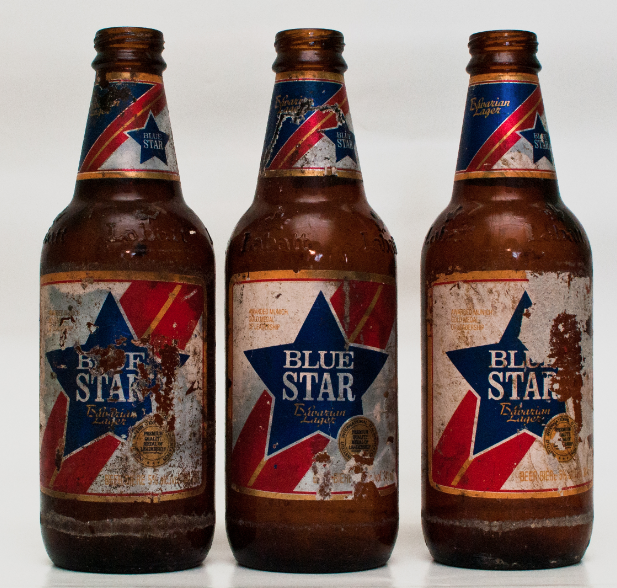
Three 1980s Blue Star bottles, my collection.

Continuing into the 1980s we see that Blue Star, out of the stubby phase, is now into more common looking Newfoundland short necks. These are embossed with “Labatt” and were found in a shed in New Chelsea in the Summer of 2012 (thanks to Keith Cooke!). They’re in rough shape, but they show the same kind of label design as before, with the red strip and the bright blue star. They do look very 80s though, don’t they?

2012 Blue Star bottle, my collection.

Which brings us to today. The 2012 version of the bottle, which uses a design from the early 1990s,  has the red stripe from the background transformed into Christopher Pratt’s Newfoundland provincial flag. The gold border has been replaced with the gold of the arrow in the flag (pointing to a “brighter future“) and the star has received some stylistic shading.

There is an interesting study on the rebranding of Blue Star in the early nineties which states that:

At that time, there was only one other product that had positioned itself as an indigenous brand of beer and that was Molson’s Black Horse. Its advertising focused on young beer drinkers and their lifestyles as students, partygoers, nightlife enthusiasts and so on – it was the Molson Canadian of Newfoundland. It should be noted that while Black Horse was known to be local in origin, the advertising was seen by many to be an imitation of mainstream North American beer advertising. As a result, this gave Labatt an opportunity to reposition Blue Star as the true local brew, with a positioning statement for Blue Star best expressed as: ‘Blue Star is the ultimate Newfoundland beer, for Newfoundlanders, by Newfoundlanders’.

Employing advertising firm Vaughn Whelan & Partners Advertising Inc,

Blue Star was positioned as ‘The Shining Star Of The Granite Planet’, a copy line that embraces the beers’ quality, its local origins, and stresses the ironic sense of humour. Tactically, we wanted to be as different from Black Horse as possible: humour versus music, radio versus TV, local versus mainland imagery. Creatively, the radio spots played up the local sense of humour and downplayed the beverage qualities. The commercials had the tag line ‘Blue Star, The Shining Star Of The Granite Planet’.

They conclude:

Together, Blue Star and Blue Star Glacier Cold are now slowly but surely chipping away at Molson’s  dominance in Newfoundland’s young adult market, while spending only a fraction of what the competition  does, and not cannibalizing other Labatt brands.

Blue Star Glacier Cold? It was one of those “ice” early-90s fad beers. What did it look like? This website has an image, but, from what I understand, it was a short lived product (really, any beer advertising itself as pasteurized has lost my confidence).

That brings us through the aesthetic changes to Blue Star over the last 50 years. Did the taste change? Did the quality? Those are much harder questions to answer. A diehard Blue Star drinker might not notice subtle changes over many years, while other might just say it always wasn’t very good (non-Blue Star drinkers, obviously). That’s the tricky thing about beer history, it’s a temporary product which leaves little trace. Even bottles rarely survive. Remember to enjoy the beers you enjoy now, for who knows how history will treat them.

Blue Star Evolution, 1960s to 2012. My collection.

Bonus! From youtube user lambchops71, a radio add from the early 1990s “shining star” series.

2 Comments

Filed under Advertisement, Bavarian Brewing, Blue Star, Labatt, Labels

The Duke of Duckworth and Blue Star

The Duke of Duckworth is one of my favorite places to drink when I’m in St. John’s, not only because they have a killer fish and chips, but because they have a great selection of local taps and a great collection of beer history memorabilia.

The Duke’s Own Sign, 2012

If you’re new to Newfoundland beer, the Duke is a must visit. They’ve usually got everything that’s currently being brewed by Storm Brewing, a few Quidi Vidi (in particular 1892), and – and this is special – the Duke’s Own. The Duke’s Own, advertised as a “private collection of uniquely brewed beer” and “Newfoundland’s Pioneer Brewpub,” is the closest to an English Ale you’re going to find being brewed in Newfoundland. While the signs seem to indicate there used to be a range of Duke’s beer, today there is only one: The Duke’s Own (an English Ale).

Here’s the deal to the best of my knowledge. The Duke used to have a very small (nano) brewery in their basement but were forced to close it to either expand their kitchen or install a women’s bathroom (accounts differ). Either way, if you ask the bartenders today they’ll tell you it’s contract brewed out of Storm brewing in Mount Pearl. They are very clear though, it’s not a Storm beer – it’s their recipe and ingredients – Storm is just the contract brewer.

The Duke of Duckworth is great for local beer selection, but they also have a great collection of beer memorabilia. They have old Tetley’s beer signs and signs for Upper Canada Dark prior to Upper Canada selling their brewery to Sleeman and converting their brands into discout beers (the brewers from Upper Canada ended up being fired and started up 3 Fired Guys brewing, better known as Steamwhistle in downtown Toronto). One piece of memorabilia that’s important for me is this fine specimen:

Blue Star (early 1980s) at the Duke of Duckworth, St. John’s. (2012)

Behind the bar (pretty much behind the Storm taps) stands this old Blue Star “The Sportsmans Friend” bottle. As I was looking at it to find the vintage, it says Labatt on the side and the stubby was phased out in the mid-1980s so it’s likely from the early 1980s, I noticed that the cap was with it.

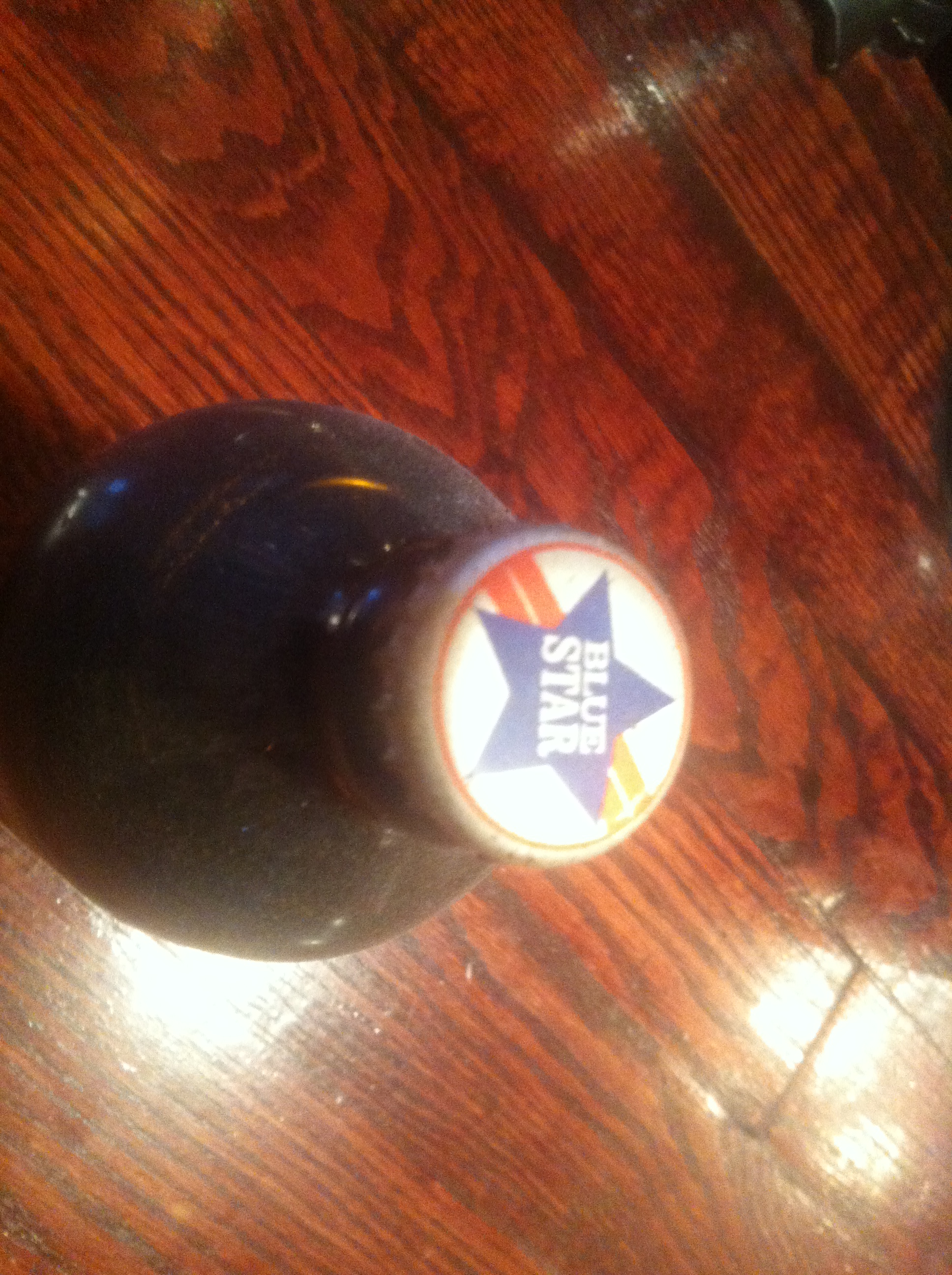
Blue Star Cap

Then I noticed something, the cap wasn’t just replaced on the top of the bottle: it was an unopened bottle of Blue Star! You can see the beer line in the above photo. Now, they didn’t seem ready to part with it, but this is an amazing find. A bottle of Newfoundland beer that’s likely over 30 years old. I’d have to fight to urge to drink it! Anyway, if you’re in town and interested in Newfoundland’s beer history, ask to see this lovely bottle.

There is also an (opened) stubby of O’Keefe’s Extra Old Stock, but that’s a mainland brand and not really my focus here. I’m sure there are other NL beer history treasures at the Duke, so be sure to search them out when you’re there!

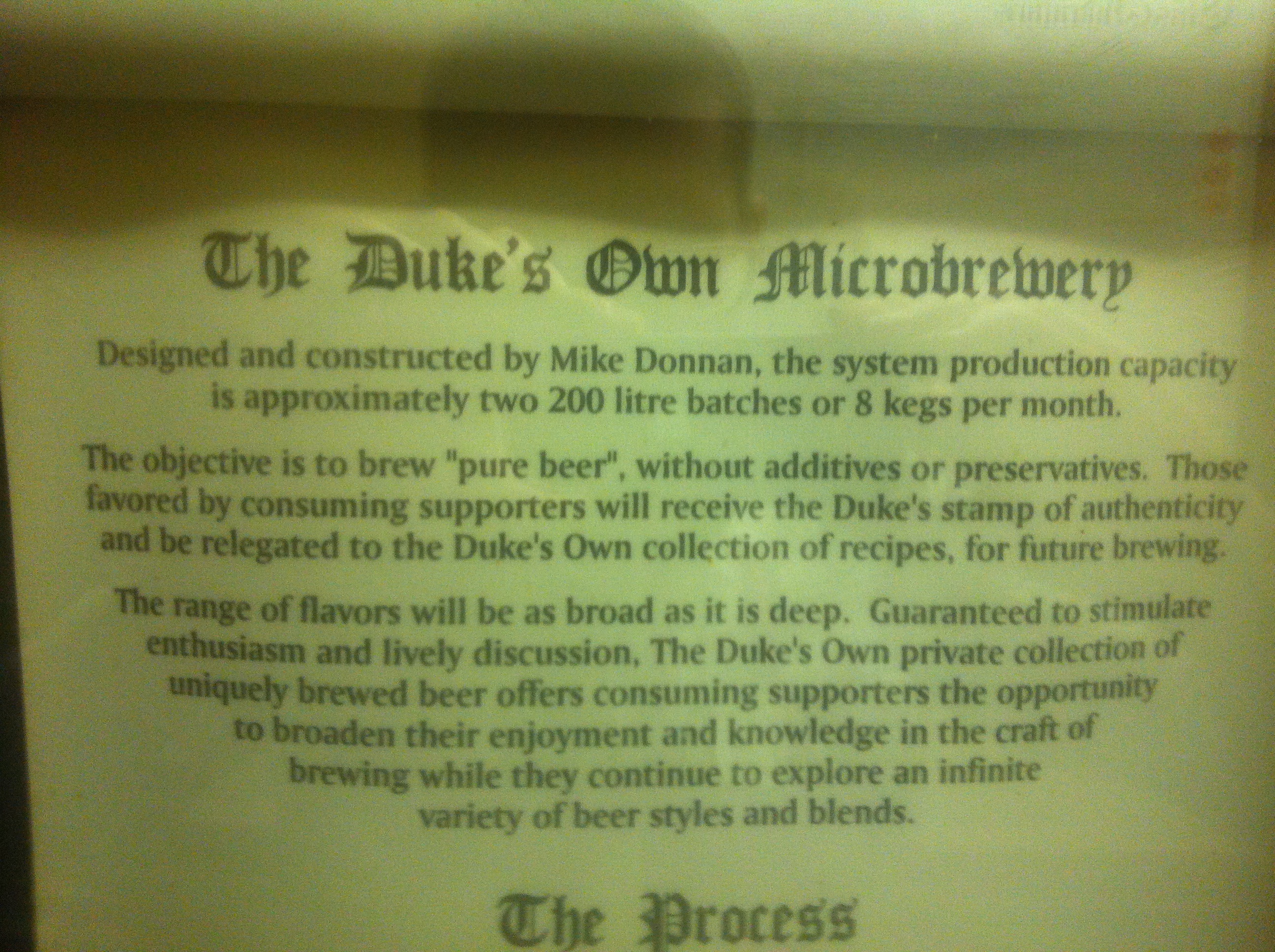
Below, as a closing note, is the Duke’s account of their microbrewery and the brewing process. You can see this poster yourself on your way to the Duke’s downstairs bathrooms.

The Duke’s Own Microbrew History

The Duke’s Own Process

The Brewing Process

Leave a comment

Filed under Advertisement, Blue Star, Contemporary Beer, Material Culture, The Duke of Duckworth

Newfoundland Beer Brands

This blog was started with the intention of unravelling the histories of some of the corner store favorites of Newfoundland beer drinkers. The thing is, I’ve been looking at the traffic that I’ve been getting on this site and I’ve noticed something: there are a lot of non-Newfoundlanders interested in our beer brands. That’s great news, but, unless they have access to a Marie’s Mini-Mart, they don’t really know what the beer scene here is all about. (Update: I’ve made this post a permanent page with larger images and a nice layout.)

Before I talk about these beers I should note that this is just about the brands made by Molson and Labatt. If you are interested in the other brewers in Newfoundland, the craft brewers and brew-pubs, then check out Quidi Vidi Brewing, Storm Brewing, and Yellowbelly. That’s all the craft beer in the provence! If you’re looking for “real ale” (cask ale) or anything that keeps up with North American Craft beer (or even a year-round IPA), you’re going to have to wait a few years.

This post is intended as an introduction to the old Newfoundland Beer Brands, what I like to call “nostalgia marcos.” They are beers brewed by the big brewers (Molson and Labatt) but that throw back to an older brewery or brand. This is not unusual in the brewing world. Latrobe Brewing, known for their Rolling Rock lager, is a brand belonging to Anheuser-Busch InBev. Alexander Keith’s is Labatt’s. Even Labatt’s beer (like Blue) are really a brand of Anheuser–Busch InBev, so there are a lot of what historians call “invented traditions” in the beer industry. Brewers, big and small alike, like to connect their beer drinkers with the long history of beer brewing.

In Newfoundland these nostalgia marcos are legendary. There are five remaining brands (two beloning to Labatt and three belonging to Molson) and almost every Newfoundlander you will ever meet will have one that they champion over the others. If your here visiting it might be worth trying some of these beers, but if your a visiting beer geek I doubt you’ll be impressed (these are brewed by the big brewers). On to the beers!

The Nostalgia Macros

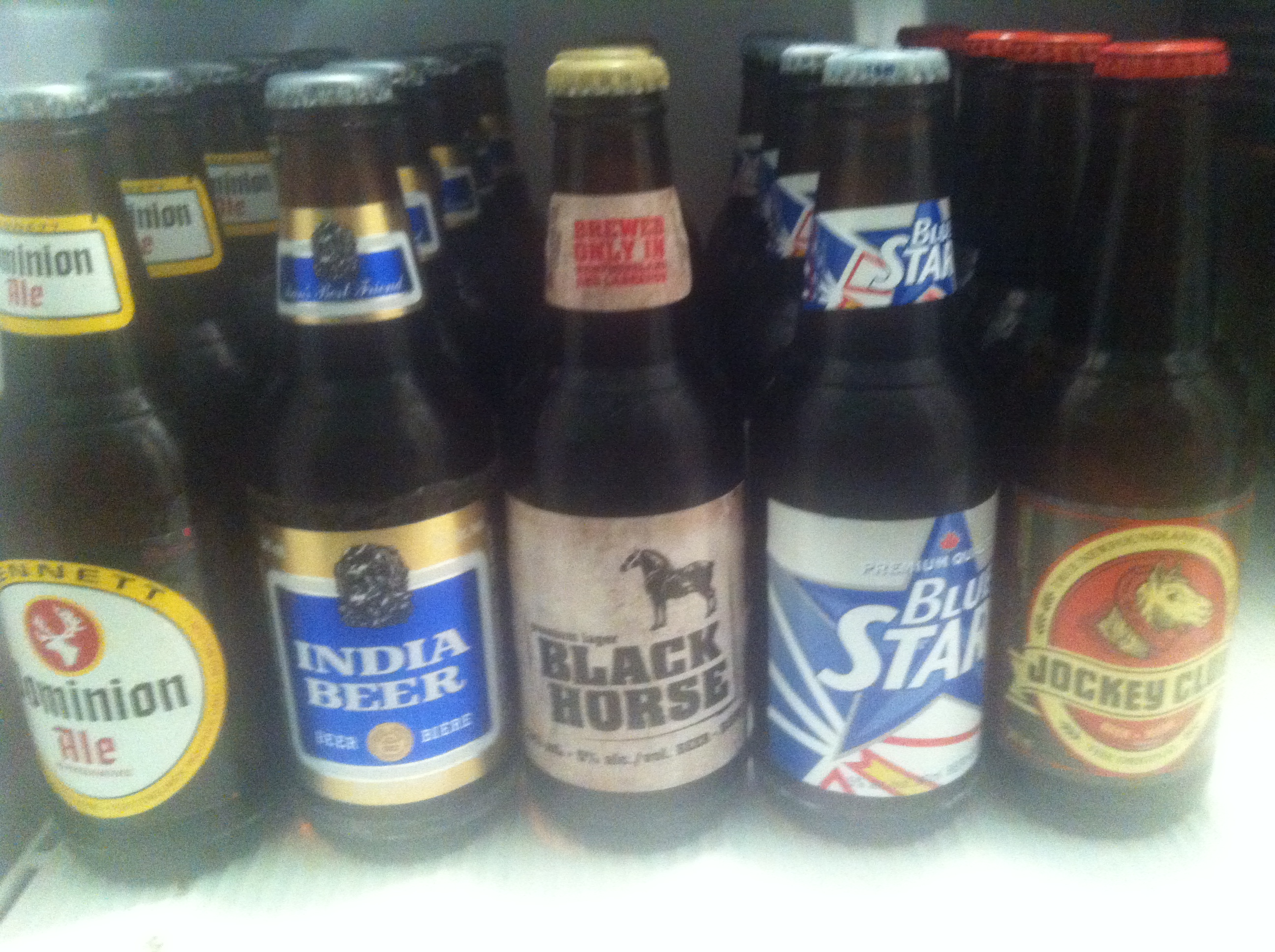
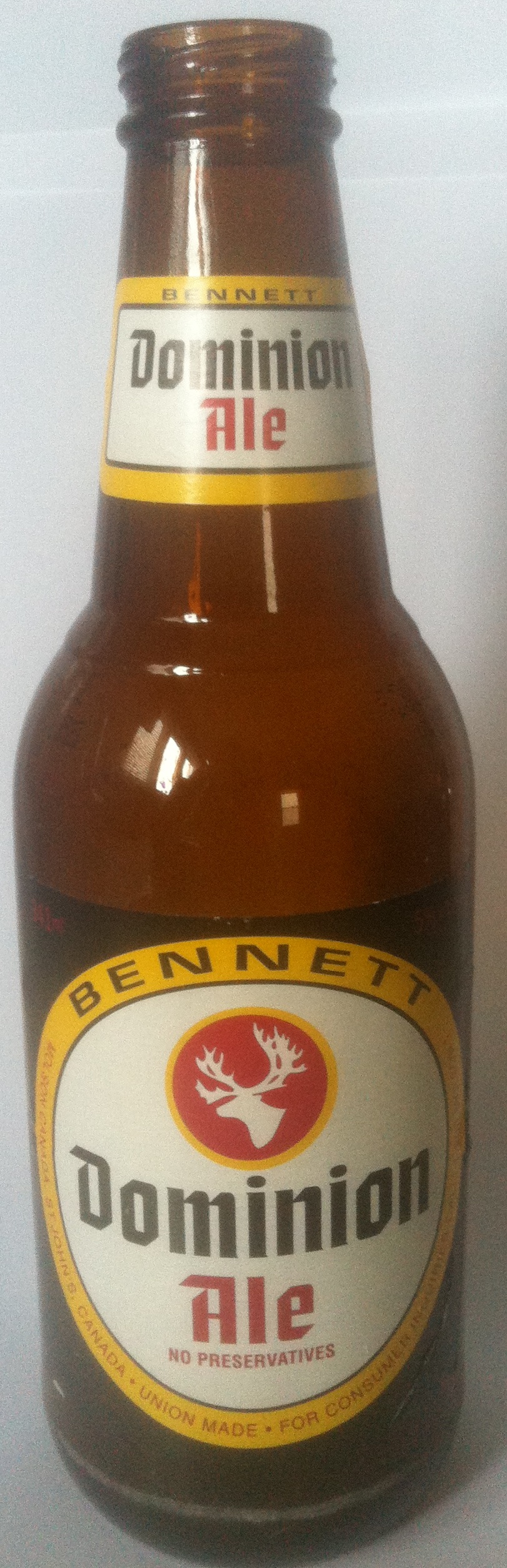
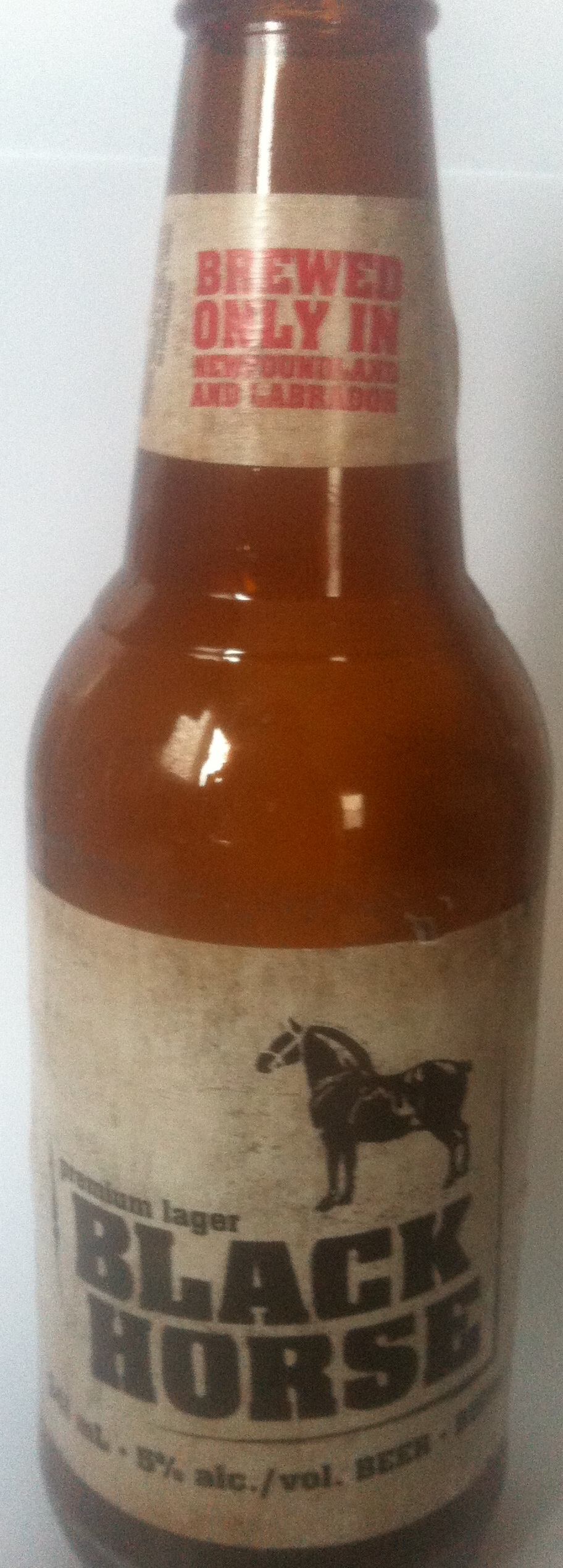
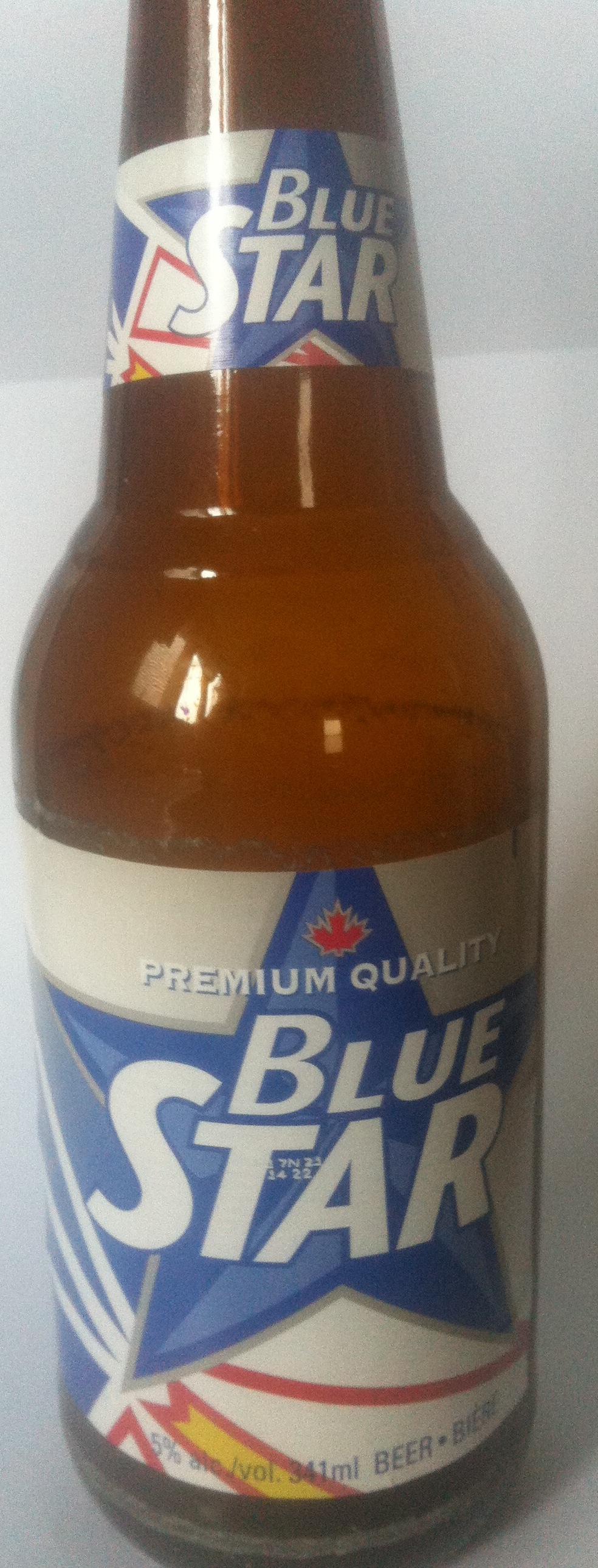
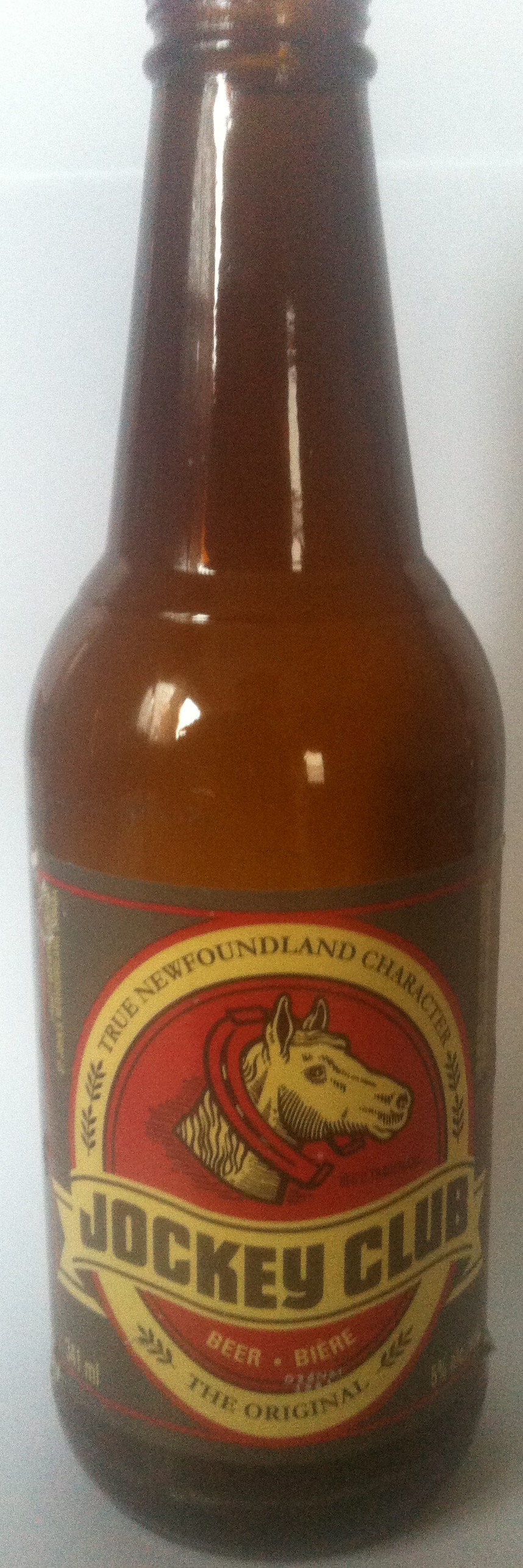
There are five traditional Newfoundland brands still being brewed: Bennett Dominion Ale, India Beer, Black Horse, Blue Star, and Jockey Club. In terms of taste and apparence they are pretty close and they are all, pretty much, fizzy yellow lagers. They come in 6 and 12 packs of semi-longneck bottles (about in inch shorter than mainland longneck bottles) which are all twist off. Blue Star, Jockey, and Black Horse all have their own printed caps, with Jockey having two different logos on the cap (either the Horse or the beer name), while India and Dominion simply have Molson caps.

From my blind taste test.

Lets talk about Bennett Dominion Ale first.

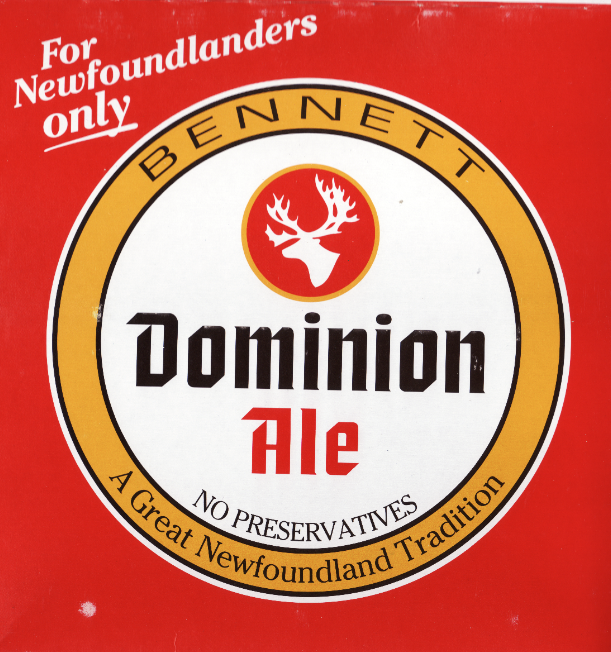
Dominion Ale Box Art circa 2012

Bennett Dominion Ale is a Molson product, brewed out of their St. John’s brewery. While it is listed as an ale, there is little of the ale taste that an American or Brit might expect. Ales are usually fermented at a warmer temperature than lagers, giving them a bigger taste, but, and this is speculation on my part, as Molson only produces lagers at the Newfoundland brewery, I suspect that this brewed at only slightly warmer temperatures than any other beer they produce. Bennett, as discussed on the main page of this project, was bought by Carling-O’Keefe and when Molson took over Carling the Bennett brands came with them. It’s really nice to see that the name lives on in this beer “for Newfoundlanders only.”

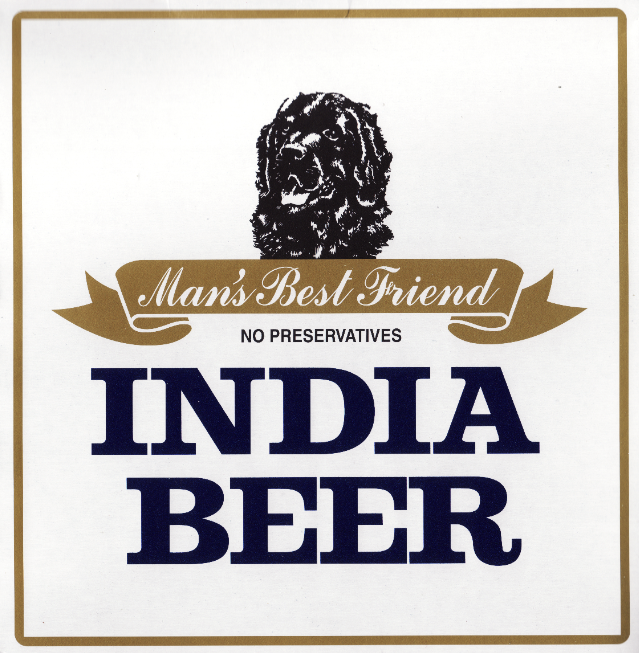
India Beer Box Art circa 2012.

Molson also brews the beer that was all the rage in the downtown music scene a few years back, India Beer. This beer, which is NOT an India Pale Ale, was brewed by the Newfoundland Brewing Company alongside their India Pale Ale. Both existed, but, as I understand, this was the lighter version. Generally people I’ve talked to describe it as a sweeter lager.
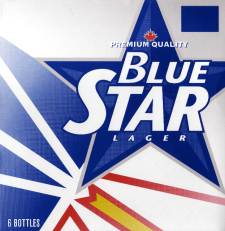
Blue Star Box Art circa 2012.

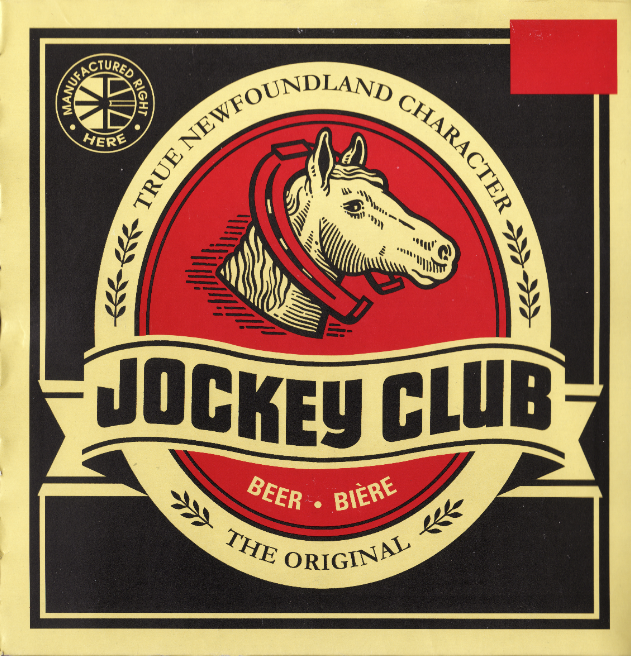
Jockey Club Box Art circa 2012.

Labatt bought the Bavarian Brewing company and still brew two of their brands, Blue Star and Jockey Club. These are the two that I find the most distinct. As a lager, Blue Star is light and clean tasting, while Jockey Club (which is still a lager or, if it is an ale, a lagered or very light one) is slightly more flavour-full. Jockey Club was advertised as the “champagne of beers” back in the Bavarian days, and, if you look really hard, you might pick up notes of cheap sparkling wine. Blue Star has a big dedicated following, particularly vocal since it was rebranded with the Newfoundland Flag in the early 1990s, while Jockey Club is often considered a bit of a joke. In two rounds of blind taste tests between these five beers I ended up preferring Jockey over the others (I usually drink double IPAs and Imperial Stouts), so take that for what it’s worth!
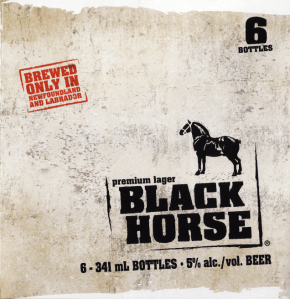
Black Horse Lager Box Art circa 2012.

The best for last. Not that it’s the best beer, but the 2010 redesign of Black Horse is really interesting for a historical point of view (the horse, which is the iconic part and on many labels on this site, now has a Newfoundland and Labrador shaped shadow on its body right before the hind legs). I mean, Black Horse Ale, as a brand, was one of the biggest in North America. It’d put Molson Canadian to shame. The Newfoundland version (which came with Carling-O’Keefe in 1962) has changed from an ale to a “premium” lager (more on this here), but the iconic black horse is still proudly on the label. It’s one of the most interesting to me, especially as they proudly say “Brewed only in Newfoundland and Labrador” when really it’s a mainlander who came here in the 1960s. There is no way you know his grandfather.
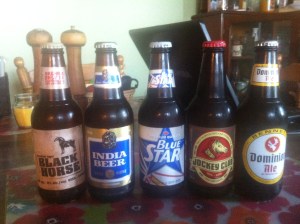
The Nostalgia Macros, 2012.

Those are the five current Newfoundland Beer Brands made by Labatt and Molson. I should note that O-Keefe Extra Old Stock was discontinued here in 2009 (it’s another beer of mainland origin), so that’s not included. These beers are great reminders of the brewing heritage in Newfoundland that was deeply rooted in independent brewers. While they might not be exciting to beer-geek tastes they are something to try when your here. If you do see them anywhere else in Canada it’s likely because of a high concentration of Newfoundlanders (like in Alberta) who still swear by their favorite brands. Will they ever get wider distribution? It’s doubtful, but then again, Labatt’s nostalgia brand in Nova Scotia, Alexander Keiths, is now a North American faux-craft beer, so anythings possible. But if you are here and looking for beers to drink be sure not to forget our craft brewers! They are writing the future of beer in Newfoundland.

10 Comments

Filed under Bavarian Brewing, Bennett Brewing, Black Horse, Blue Star, Contemporary Beer, Dominion Ale, India Beer, Jockey Club, Labels, Newfoundland Brewery, Overview

Jockey Club: An Honest Uncomplicated Brew

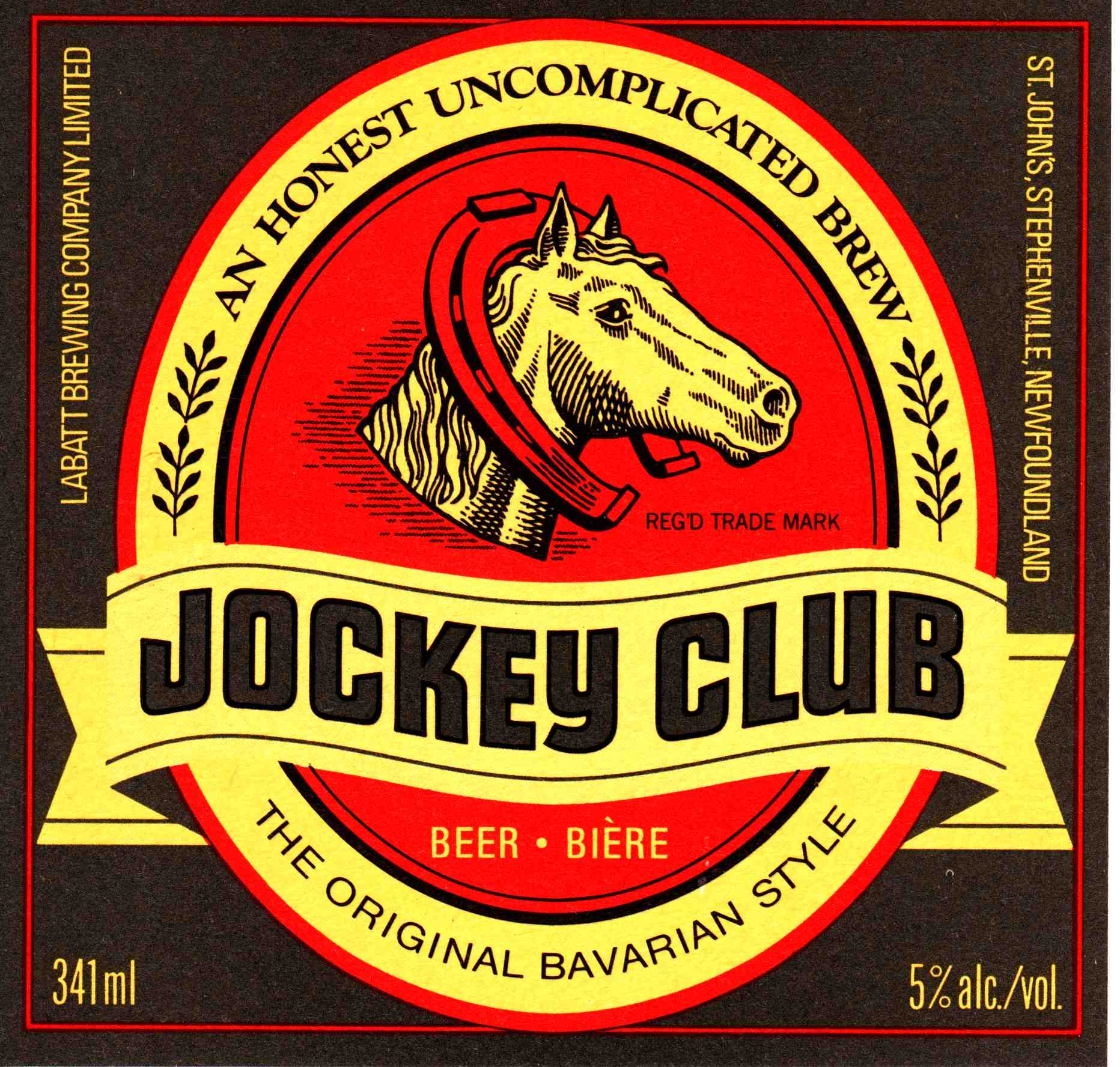
I love adding more historical Newfoundland beer bottle labels to my collection and this one is no exception. Today I finally got a copy (two actually) of this Jockey Club label.

Jockey Club

The site I picked this up from states that its from the 1960s and was old stock that was never used. The date seems to be fairly believable (at least for our purposes), as it would be after the 1962 buy-out of the Bavarian Brewing Company Limited by Labatt, however, because the label lists Stephenville as part of the Labatt’s brewing organization this is likely from the 1970s.

Labatt took control of the old Bison Brewing Company brewery in 1974 and operated there until 1981, so it’s probable that this label comes from the late 1970s when Labatt had two operations in the province.

Dating the label aside, from my understanding this slogan “An Honest Uncomplicated Brew, the Original Bavarian Style” (which is great, isn’t it?) was used from the 1960s until the early 1990s when it was changed to “True Newfoundland Character” (this would be around the time Labatt rebranded Blue Star to be adorned with the Newfoundland Flag and ran the “Shining Star of the Granite Planet” series of advertisements”). I like to think that the “Bavarian Style” they are referring to has more to do with the Bavarian Brewery, who they inherited the beer from, rather than the area of Germany where the Bavarian Brewery got its name. Either way, it’s a great label which I’m quite happy to have a copy of!

1 Comment

Filed under Bavarian Brewing, Jockey Club, Labatt, Labels

Black Horse Beer. The Thoroughbred?

A strange thing happened to Black Horse over the years.  Most people in the United States and Canada who remember the brand (from anytime before the mid-1970s) will remember the beer as an ale. The picture I use on the main page, a Canadian Dow’s label from 1972, plainly states “Black Horse Ale.”

Black Horse Ale - 1972

Black Horse circa 1972

But there is somethings fishy with the Newfoundland product: it was rebranded to “Black Horse Beer” and made into a lager. This is pretty much the trend in North American beer at the time, everyone was mimicking the lighter tastes of American Beer and the big three Canadian brands wanted to follow suit. (See Ian Coutts, Brew North: How Canadians Made Beer and Beer Made Canada, Greystone, 2010, for a well researched and beautifully illustrated overview.)

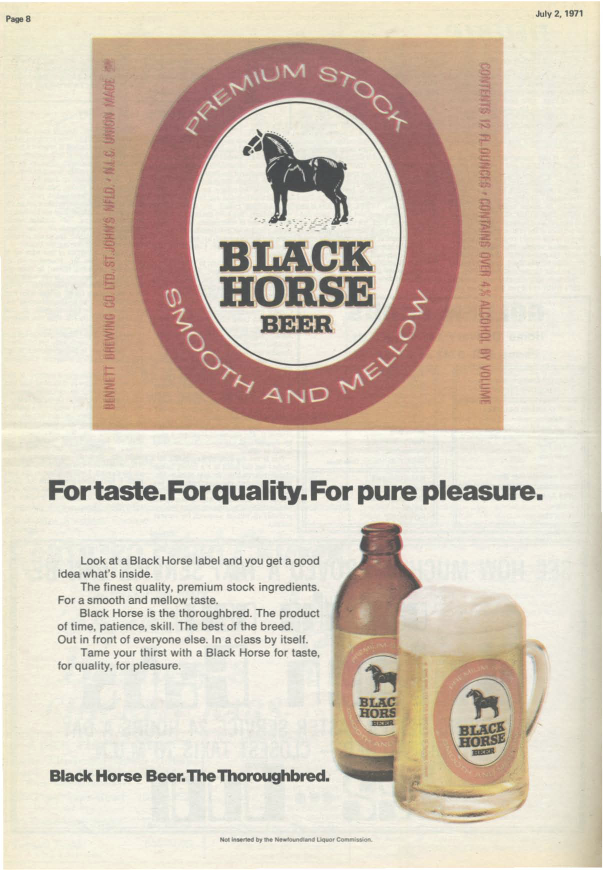
When did Black Horse Ale and Black Horse Beer (the lager) part ways? Well, for sometime both must have existed. Check out this full page advertisement for Black Horse from a 1971 issue of the MUSE (the student newspaper for Memorial University of Newfoundland):

It’s a great advertisement, not only because it’s full of great copy about Black Horse, but also because it gives us a close up of the label. It still says it’s brewed by Bennett Brewing, which at the time was under the ownership of Canadian Breweries Limited (who gained control over the prestigious Black Horse brand after their 1952 purchase of National Breweries – which they renamed Dow Breweries). In all other ways the label is identical to the Canadian Black Horse Ale label.

Present-day Black Horse logo, from my well-worn baseball cap.

I wonder if the flavour of the two beers were similar and if the brewing of ales and lagers was starting to converge (ales becoming more watery and lagers becoming more bland) so that all beer just tasted like “beer.” Either way, the Newfoundland Black Horse, since at least the early 1970’s, has been a lager. While now it’s marketed as a “premium lager,” its interesting to think how far it’s come from it’s ale heritage. Thoroughbred? I think not.


Oh well!

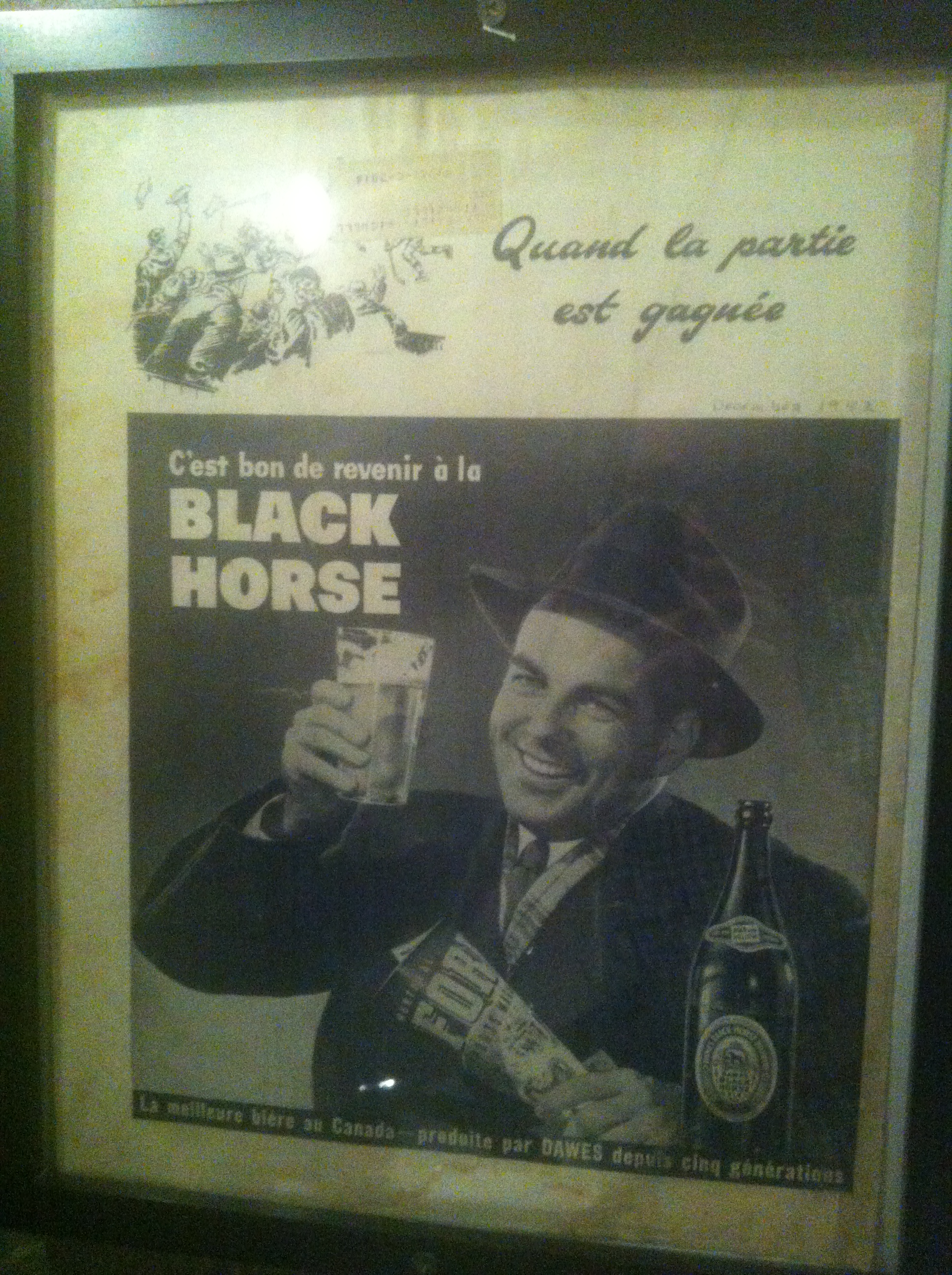
1942 french newspaper advert for Black Horse Ale, framed as art in the Beer Bistro mens washroom in downtown Toronto.

1 Comment

Filed under Bennett Brewing, Black Horse, History, Labels

Some Quirky Old Brands

I was re-watching a youtube compilation of old Newfoundland beer labels this morning and I realized that searching for them online didn’t bring up any results. Anyone looking for a history of Bavarian Brewing’s Bulldog beer would be totally out of luck. Here, I’m going to list a few of the brands highlighted in the video.

The original video can be watched here on YouTube. It’s not my content and I did not make the video, so don’t blame me if you don’t like the song they use!

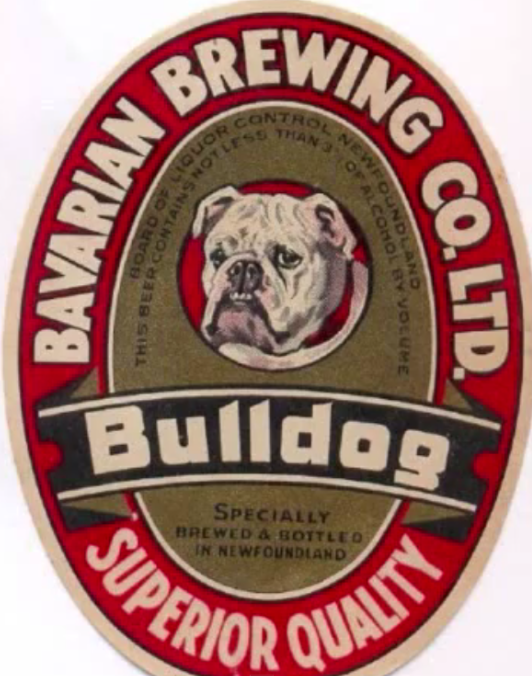
From Bavarian Brewing Company we have Bulldog Newfoundland Style Beer, the Silver Doctor Summer Special, an Irish Style Porter, and their Three Star Lager. I’m guessing the Bulldog would be an ale, but I have no idea about the Silver Doctor. Sounds good!

Bull Dog Newfoundland Style (Bavarian Brewing)

Bulldog (Bavarian Brewing)

Silver Doctor Summer Special (Bavarian Brewing)

Three Star Lager (Bavarian Brewing)

Irish Style Porter (Bavarian Brewing)

From Newfoundland Brewing we have Moose Pale Ale, their Old Stock India Pale Ale, “India’s Holiday Bock Beer,” and a Red Top Golden Amber. These all sound amazing. Moose Pale Ale! How Newfoundland is that? Plus another India Pale Ale, an amazing 8% bock (a dark German spring beer), and an amber ale! What a line up!

Moose Pale Ale (Newfoundland Brewing)

India Pale Ale (Newfoundland Brewery)

India’s Holiday Bock Beer (Newfoundland Brewing) – 8%!

Red Top Golden Amber Beer (Newfoundland Brewery)

From Bennett Brewing we’re just missing Bennett’s beer. I love that green-and-black colour combination.

Bennett’s Beer (Bennett Brewery)

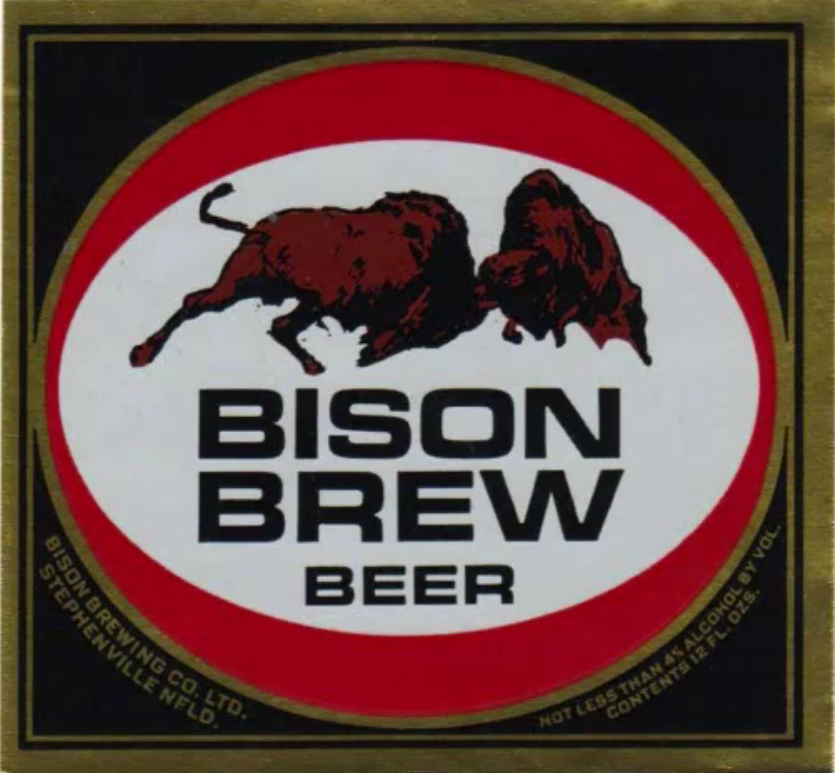
From the short lived Bison Brewing (in Stephenville) we have their flagship beer, Bison Beer.

Bison Brew Beer (Bison Brewing)

While they are harder to find, it’s important to remember that these old breweries didn’t just produce the scattered few brands that the big Canadian Breweries kept after 1962. They had a full line of beers for all sorts of different preferences. Plus, they are really beautiful labels!

5 Comments

Filed under Atlantic Brewery, Bavarian Brewing, Bennett Brewing, Labels, Newfoundland Brewery, Other Brewers